| Stone Type | Glass & CZ Stones |
| Weight (g) | 0.00 |
| Colour | Green |
| Occasion | Wedding, Festival, Traditional |
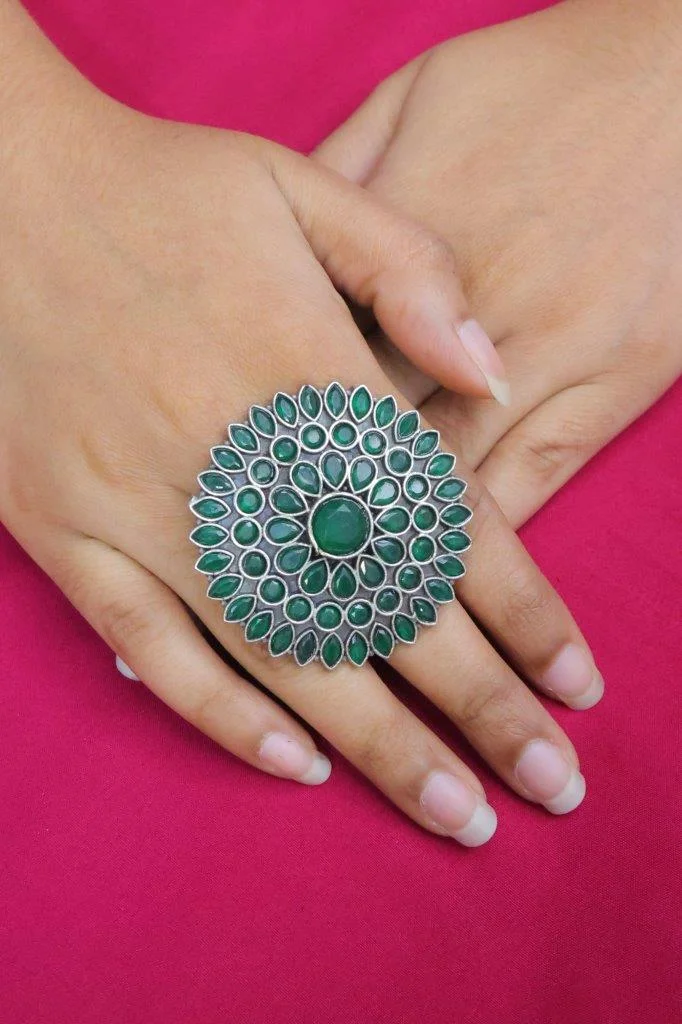
A large round flower built entirely out of stones. A single round cabochon sits at the centre, and around it radiate two concentric rings of pear-cut stones set point-inward, each in its own bezel, packed close enough that almost no metal shows between them. The outermost edge is finished with a plain rim.
This is the South Indian temple arrangement, and the logic behind it is worth knowing. Temple jewellery is designed to be read from a distance, in low light, by people standing some way off — so it uses massed stones of one or two colours in a radiating pattern rather than fine detail, because a radiating pattern still reads as a flower when you cannot see the individual settings. It is the opposite design philosophy from the carved rings in this range, which only work close up.
The stones are glass and cubic zirconia rather than gemstones, hand-set into closed metal bezels. That is the traditional setting for Indian costume jewellery and it does two useful things at once: a closed back holds the stone against the knocks a ring takes, and the dark oxidised rim around it keeps the colour reading clearly instead of washing out against the metal.
Two colourways are stocked. Green is the deeper and more traditional of the pair — green and gold is the standard temple pairing, and against oxidised silver it reads almost black at a distance with the stones lighting up only when they catch. Ruby is the brighter pink-red and the easier one to notice across a room.
The piece is brass, plated and then oxidised — chemically darkened and polished back, so the blackening stays in the recesses while the raised surfaces come up bright. That contrast is the whole point of the finish: it is what makes shallow carving read as deep carving, and it is why an oxidised ring at this price can look like worked silver from across a table.
This ring is adjustable. The band is not a closed circle — it is a tapered strip coiled so the two ends overlap behind the finger, and you open or close it by a few millimetres with your fingers. In practice that covers most adult sizes, roughly a UK J to a UK S, which is why almost all Indian fashion rings are made this way: nobody has to know their ring size, and the same ring still fits when knuckles swell in summer.
Adjust it off the finger, not on it, and move it gradually. Opening and closing the same band repeatedly is what eventually tires the metal, so set it once to your finger and leave it there.
Stock on this design is thin — two or three pairs per colour — which is usually the case with the stone-heavy pieces, because setting thirty-odd stones by hand is slow.
Wear it alone, on the index or middle finger, with a saree or a silk kurta. It is a festival and wedding ring rather than a daily one; the stones stand proud enough that it is not comfortable under a glove or in a pocket.
Rings take more punishment than any other piece of jewellery because hands do the work. The things that actually shorten a plated ring's life are water, soap, hand sanitiser, perfume and cooking oil, in roughly that order. The habit worth building is simple: the ring goes on last when you are dressing and comes off first when you are washing up, bathing, cooking or swimming.
Clean it with a dry soft cloth only. Never use a silver dip or a polish — a dip strips an oxidised finish completely and will take gold plating with it, and a polish wears plating thin at exactly the high points you want to keep bright. Store it dry and on its own, because rings scratch each other in a shared box.
| Stone Type | Glass & CZ Stones |
| Weight (grams) | 0.00 |
| Colour/Finish | Green |
| Occasion | Wedding, Festival, Traditional |
| Gender | women |
| SKU/Product Code | KEYU-NAA3086 |