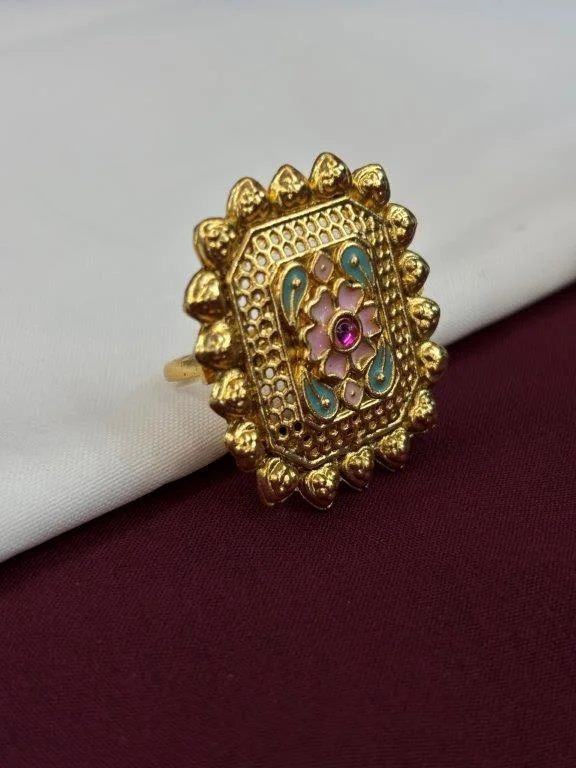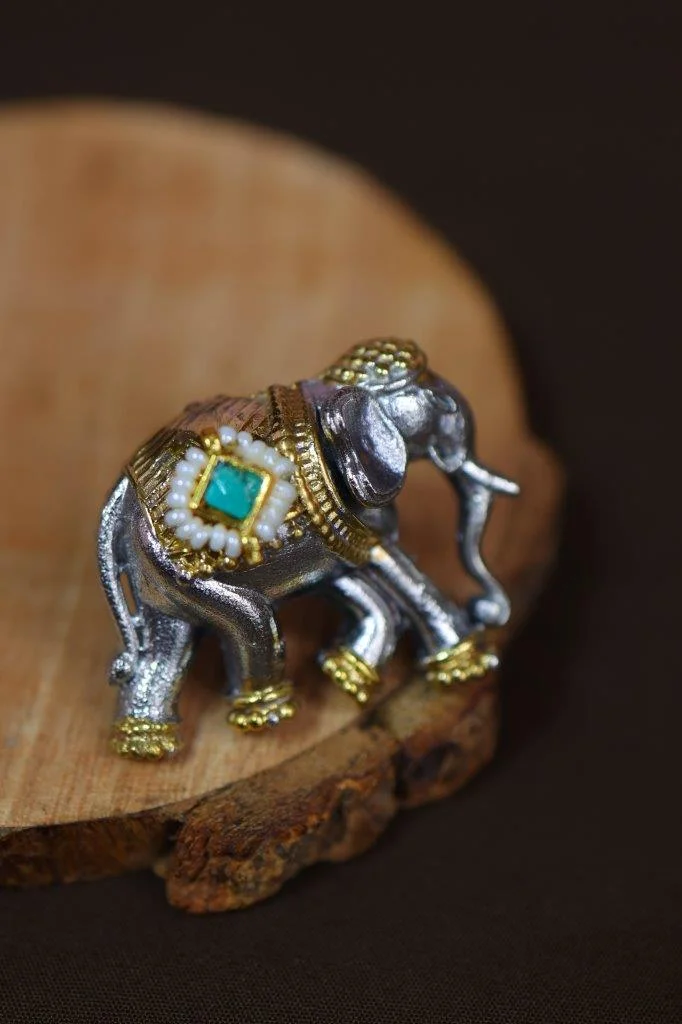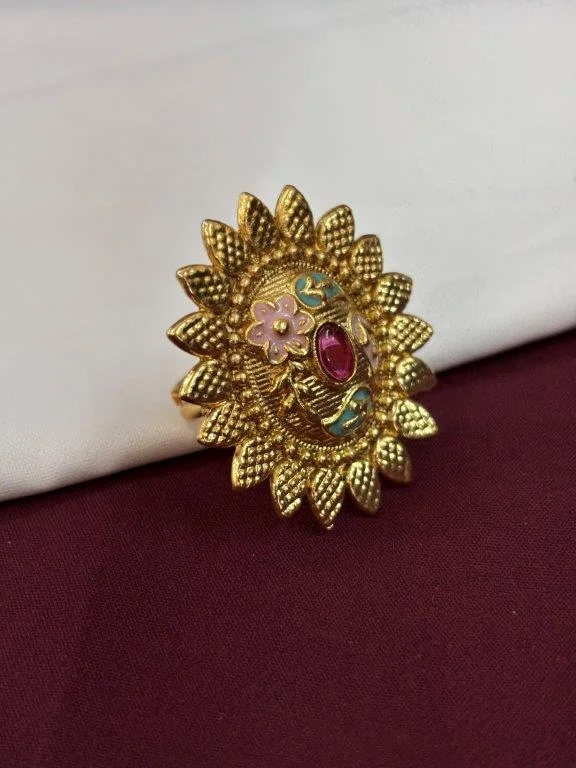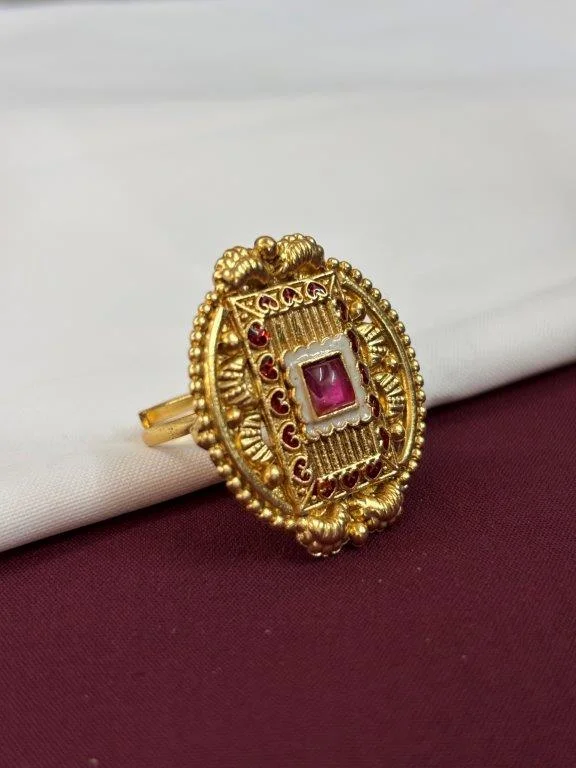
| Stone Type | Enamel & Pearl |
| Weight (g) | 0.00 |
| Colour | Black |
| Occasion | Festival, Party, Traditional |
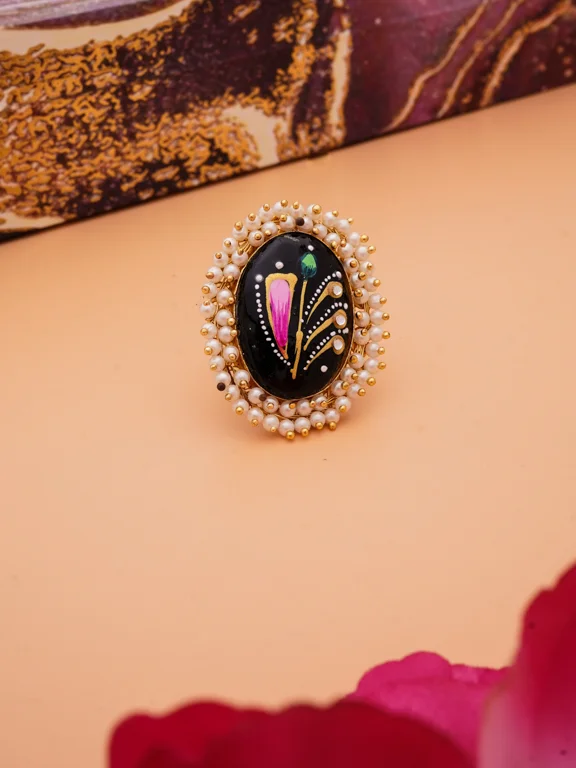
The only painted piece in this range. An oval panel carries a floral spray — a curving stem with buds and leaves, worked in pink and gold on a dark ground — and around the whole edge runs a close double row of small white pearls.
Painted panels in jewellery are a Mughal and Persian inheritance, and the convention here is a specific one: a single spray of flowers growing from a point, seen flat-on, with no background scenery. That motif runs through Mughal textiles, manuscript borders and marble inlay, and it is still what you find on Jaipur enamel today. It is worth looking at the stem of this one — the curve is what carries the design, and a stiff stem is the quickest way to tell cheap work from good.
The coloured areas are meenakari — powdered coloured glass packed into recesses cut in the metal and fired until it fuses into a hard enamel. It is done by hand, which is why the edges of each colour stop in a slightly different place on every piece. That variation is the mark of the technique rather than a defect, and it is the quickest way to tell hand-enamelled work from printed or painted imitation.
The pearl border is doing something specific against a dark panel. A painted ground absorbs light instead of reflecting it, so a plain metal rim would leave the ring looking flat and dead at the edge. Pearls return a soft light all the way round and lift the panel off the hand.
Two colourways are stocked: Red and Black, which refer to the ground the flowers are painted on. Black is the more dramatic and shows the gold of the painting better; red is warmer and reads as more traditional.
The piece is brass with a gold-tone plating. It is not gold and is not sold as gold — what it gives you is the warm colour and the weight of a much more expensive ring, in something you can wear to a wedding without thinking about it, and replace without regret if it is lost.
This ring is adjustable. The band is not a closed circle — it is a tapered strip coiled so the two ends overlap behind the finger, and you open or close it by a few millimetres with your fingers. In practice that covers most adult sizes, roughly a UK J to a UK S, which is why almost all Indian fashion rings are made this way: nobody has to know their ring size, and the same ring still fits when knuckles swell in summer.
Adjust it off the finger, not on it, and move it gradually. Opening and closing the same band repeatedly is what eventually tires the metal, so set it once to your finger and leave it there.
Treat the painted surface as the fragile part. It is enamel or lacquer on metal, and a hard knock against a counter or a car door will chip it in a way that cannot be repaired. Take it off before anything that risks that, and it will stay bright indefinitely.
Rings take more punishment than any other piece of jewellery because hands do the work. The things that actually shorten a plated ring's life are water, soap, hand sanitiser, perfume and cooking oil, in roughly that order. The habit worth building is simple: the ring goes on last when you are dressing and comes off first when you are washing up, bathing, cooking or swimming.
Clean it with a dry soft cloth only. Never use a silver dip or a polish — a dip strips an oxidised finish completely and will take gold plating with it, and a polish wears plating thin at exactly the high points you want to keep bright. Store it dry and on its own, because rings scratch each other in a shared box.
| Stone Type | Enamel & Pearl |
| Weight (grams) | 0.00 |
| Colour/Finish | Black |
| Occasion | Festival, Party, Traditional |
| Gender | women |
| SKU/Product Code | KEYU-NAA722 |