| Weight (g) | 0.00 |
| Colour | Silver |
| Occasion | Festival, Traditional, Daily Wear |
The elephant at the head of this pin is shown in profile with its trunk curled upward, and its whole body is covered in engraving — concentric swirls over the shoulder and haunch, rows of punched dots along the back, a patterned ear. The engraving is not an attempt at realism. It is the folk convention of Kutchi and Rajasthani metalwork, where an animal is covered with pattern the way a block-printed cloth is, and the result reads as a textile motif made solid.
The piece is oxidised: darkened all over, then polished back, so the blackening stays down in the engraved lines while the raised surfaces return to bright silver tone. On a piece this densely worked, that is what makes it legible — polished bright, the swirls would disappear into a single shining lump; oxidised, every line reads.
A raised trunk is the auspicious way to show an elephant, which is why it is almost always modelled that way in Indian ornament, and it is the one motif that is welcome at a wedding, a puja, a housewarming and an ordinary Tuesday without adjustment.
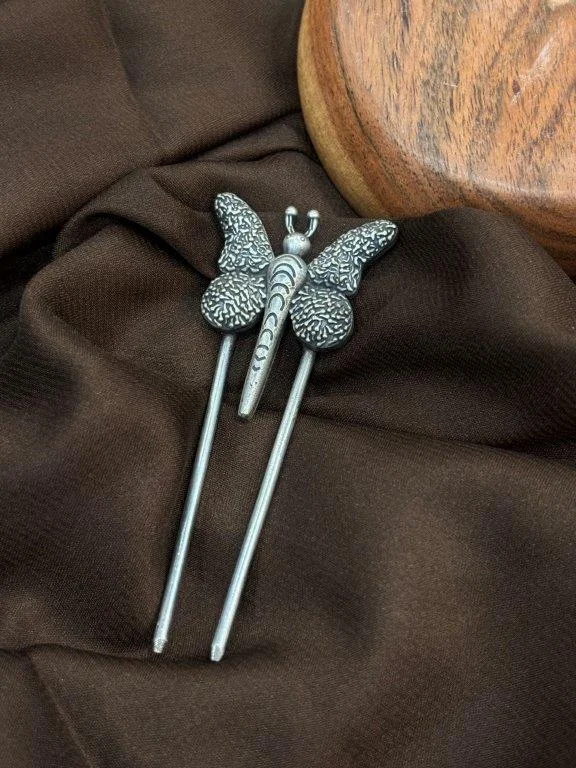
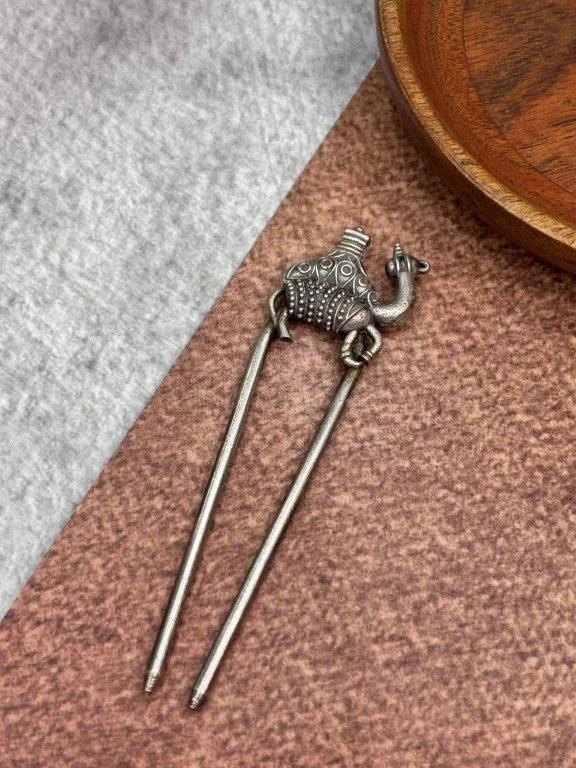
There are no stones. Below the figure the pin is two plain prongs, smooth and slightly tapered, and they are what does the work: pushed through the coil of a bun they hold it by friction, with no clip or spring to wear out. Push the pin in at the edge of the bun, angled slightly downwards, let both prongs pass under the coil, then bring the tips back out the far side so they lie flat against the head. Pushed straight in it will loosen within an hour.
It is the cheapest and plainest piece in this range of hair ornaments, which makes it the sensible first one to buy. It tells you whether you get on with a juda pin at all — whether your hair is thick enough to hold one, whether you reach for it — before you spend more on a stone-set or dual-tone version. It also works slid across a thick plait rather than a bun.
Base metal is brass with an oxidised silver-tone finish. Keep it out of hairspray, which dulls plating faster than ordinary wear does: spray first, let it dry, then pin, and wipe it with a dry cloth before it goes back in its pouch.
One last thing in its favour: there is nothing on it to break. No stones to fall out of bezels, no pearls on links, no moving parts. A plain cast figure on two prongs is about as robust as jewellery gets, which is why this is the one to put in a travel bag or to keep at the office rather than the piece you have to think about.
This is brass given an oxidised, antique-silver finish rather than solid silver. The metal is darkened and the raised surfaces are then polished back, so the blackening stays in the recesses while the high points stay bright. That contrast is the whole point of oxidised work — it is what makes every engraved line and pierced opening read separately instead of dissolving into one shiny surface, and it means small variations between pieces are normal rather than faults.
Put this on after perfume, hairspray and hand cream, and take it off before washing, swimming or sleeping. Wipe with a dry soft cloth and use a dry soft brush around the stone settings and between any pearls, where a cloth cannot reach. Store it in a zip-lock pouch — which is what the supplier themselves advise, and the single most effective thing for a plated piece, because it keeps humid air off the metal. Never use silver polish, dip cleaners or an ultrasonic cleaner.
| Weight (grams) | 0.00 |
| Colour/Finish | Silver |
| Occasion | Festival, Traditional, Daily Wear |
| Gender | women |
| SKU/Product Code | KEYU-NAA936 |