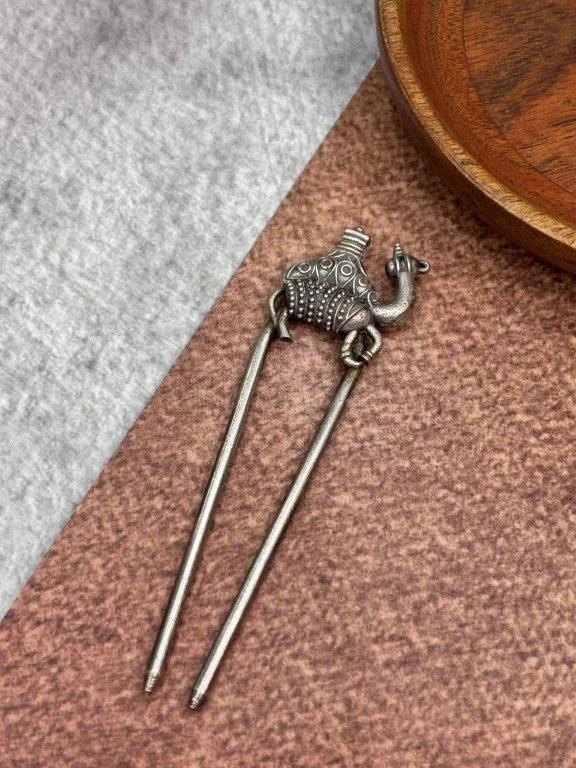
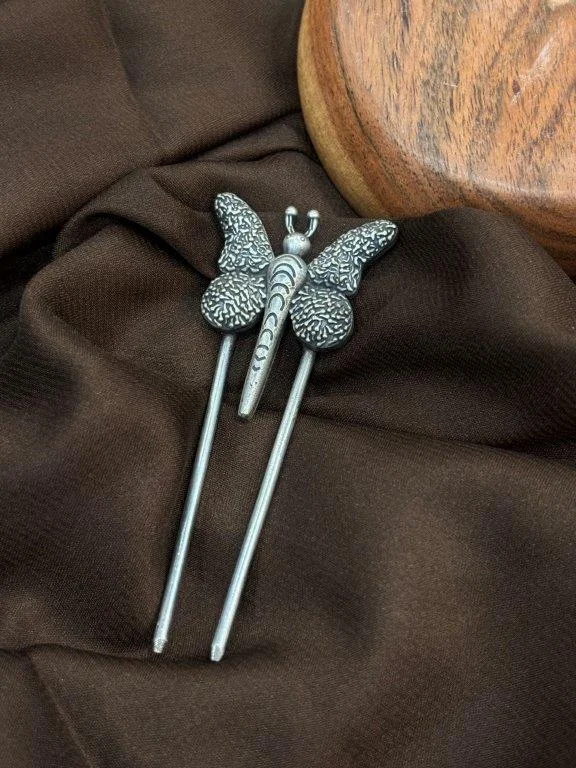
| Stone Type | Paachi Kundan, Pearl |
| Weight (g) | 0.00 |
| Colour | Turquoise |
| Occasion | Wedding, Festival, Traditional |
The elephant on this juda pin is caparisoned — dressed, as a temple elephant is dressed for a procession. The body is modelled in bright silver tone with the ears and legs worked separately, and over it sit gold-tone elements: the saddle cloth, the headpiece, the ornament across the forehead. Two paachi stones are set into the arrangement, a teardrop above the head and a larger oval on the saddle, and below the whole figure hang clusters of small white pearls with gold ghungroo bells among them.
It is offered in four stone combinations, and because the stones are the only colour on an otherwise two-tone piece, each reads quite differently:
Paachi stones are foil-backed and set into raised bezels, so they glow evenly rather than sparkling off facets. On a figure that is already busy with cast detail, that even glow is the right kind of brightness — faceted stones would have fought the modelling.
The pin is 5.5 inches, a full-length two-prong fork. The prongs are plain and smooth and do the actual work: they pass through the coil of a bun and hold it by friction, which is why a juda pin carries heavy hair better than any clip. Push it in at the edge of the bun angled slightly downwards, let both prongs travel under the coil and bring the tips out the far side so they rest against the head. Pushed straight in, it will loosen; threaded properly, it will not move.
Wear it with the hair drawn back smoothly so the elephant is read in profile. It is a strong piece — the largest motif of the juda pins in this range, and the only one with a hanging fringe — so keep whatever is at the ears small. It suits a silk saree, a festive kurta and temple jewellery, and it is a good gift precisely because the elephant is the least controversial motif in Indian ornament.
One practical point about a pin with a fringe, since this is the only one here that has one. Pearls and bells on short links sit against the hair, and fine hair catches around them when the pin is pulled straight out. Take it out the way it went in — back along the same angle, so the prongs retrace their path — rather than lifting it away from the head, and the fringe comes free without taking anything with it.
Base metal is brass with gold and silver tone platings. Stock varies by colourway and the four do not move at the same rate, so this is listed for WhatsApp enquiry rather than direct checkout — tell us which you want and we will confirm what is in hand.
Dual-tone means two platings on one piece — a bright silver tone and a warm gold tone, applied to different parts of the same design so each section reads separately. It is harder than a single finish because the two have to be masked off from one another, and it is why these pieces show their detail so clearly: the eye separates the gold elements from the silver ones before it has read a single stone. The base metal underneath is brass, so this is plating rather than solid gold or silver.
Put this on after perfume, hairspray and hand cream, and take it off before washing, swimming or sleeping. Wipe with a dry soft cloth and use a dry soft brush around the stone settings and between any pearls, where a cloth cannot reach. Store it in a zip-lock pouch — which is what the supplier themselves advise, and the single most effective thing for a plated piece, because it keeps humid air off the metal. Never use silver polish, dip cleaners or an ultrasonic cleaner.
| Stone Type | Paachi Kundan, Pearl |
| Weight (grams) | 0.00 |
| Colour/Finish | Turquoise |
| Occasion | Wedding, Festival, Traditional |
| Gender | women |
| SKU/Product Code | KEYU-NAA2233 |