| Stone Type | Paachi Kundan, Pearl |
| Weight (g) | 0.00 |
| Colour | Multi Color |
| Occasion | Festival, Traditional, Daily Wear |
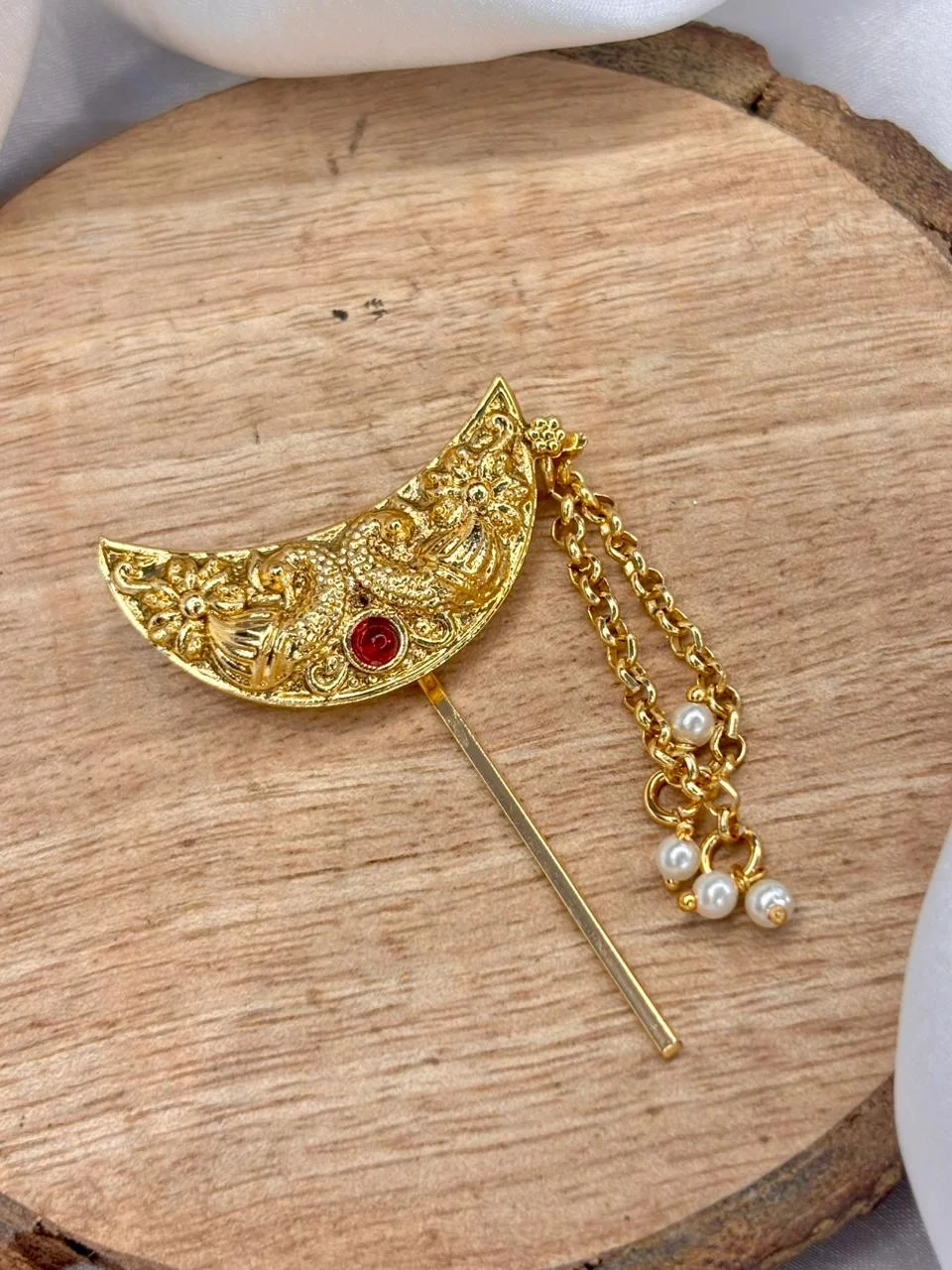
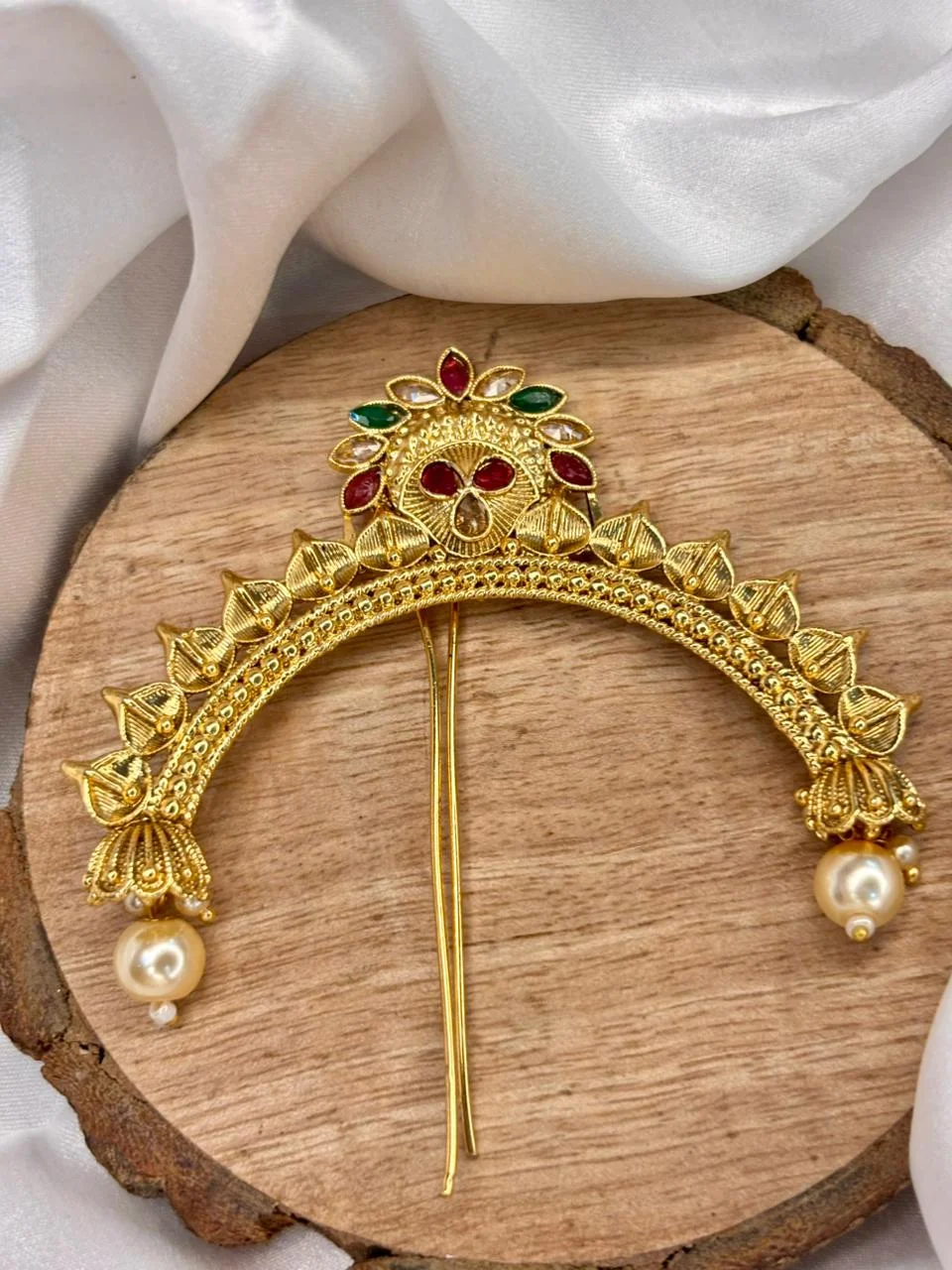
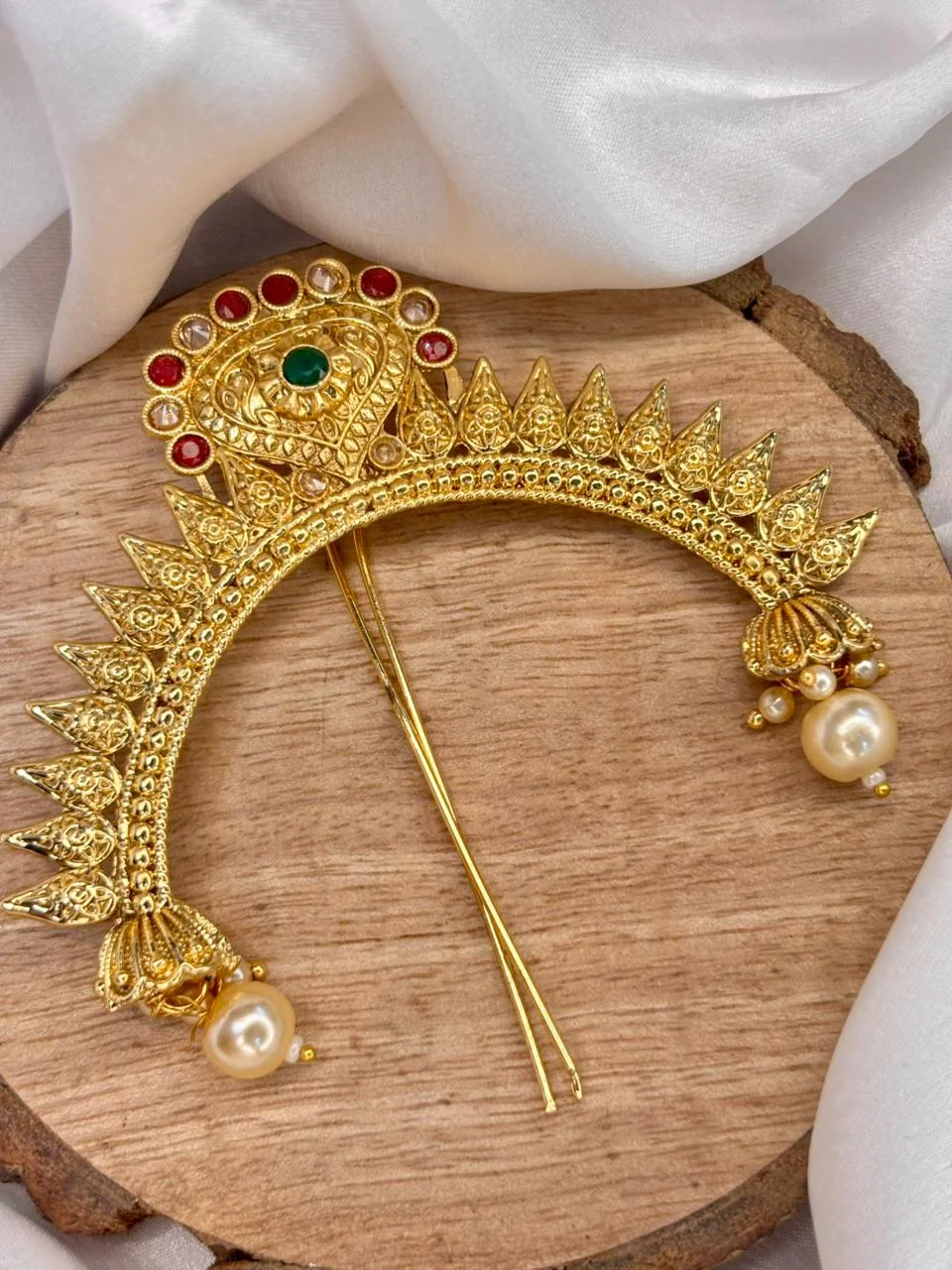
Two cows stand back to back at the top of this juda pin, modelled in silver tone with their heads turned outward and their legs cast free of the body, and between them sits the piece's centrepiece: a gold ornament set with a red stone at the top, a green stone at its heart, and a close ring of tiny white pearls around the whole arrangement.
The symmetry is doing the work here. A single animal gives a hair ornament a direction, which means it only looks right from one side. A facing or back-to-back pair reads the same from either side and centres itself above the bun, which is why so much temple and tribal jewellery is built on paired animals. Seen from behind — which is how a juda pin is actually seen — this one resolves into a symmetrical arrangement rather than a sideways silhouette.
The cow is the obvious subject for a piece meant for a woman's hair in India, and it carries its meaning without needing to be explained. What stops it from being merely pious is the treatment: these are not decorative cartoons but small sculptures, with the hump, the dewlap and the set of the legs all modelled, in the folk idiom of Rajasthani and Kutchi silver rather than the smooth style of a mass-market casting.
The stones are paachi — foil-backed, set into raised bezels, glowing evenly instead of sparkling. Against bright silver and gold tone the red and green read as deep rather than bright, which is the point of the technique.
The pin is 4.5 inches, slightly shorter than the 5.5-inch forks in this range, which makes it the easier one for medium-length hair or a smaller bun. The prongs pass through the coil of the bun and hold it by friction. Push it in at the edge, angled slightly downwards, let both prongs travel under and bring the tips out the far side so they lie against the head.
Wear it with the hair smooth and the bun low, so the pair sits level. It works with a cotton or silk saree, with a plain kurta, and particularly well for a puja or a festival, where the subject is appropriate as well as decorative.
Base metal is brass with gold and silver tone platings.
A word on the cast legs, which are the one part of a piece like this that can be damaged. On both animals the legs stand clear of the body rather than being moulded flush against it, and that openwork is exactly what makes the figures read as sculpture rather than as a flat plaque. It also means they can be bent if the pin is dropped on a hard floor or pushed into a crowded bag. Store it in its own pouch rather than loose, and it will keep its shape indefinitely.
Supplier stock on this one is very limited, so it is listed for WhatsApp enquiry rather than direct checkout.
Dual-tone means two platings on one piece — a bright silver tone and a warm gold tone, applied to different parts of the same design so each section reads separately. It is harder than a single finish because the two have to be masked off from one another, and it is why these pieces show their detail so clearly: the eye separates the gold elements from the silver ones before it has read a single stone. The base metal underneath is brass, so this is plating rather than solid gold or silver.
Put this on after perfume, hairspray and hand cream, and take it off before washing, swimming or sleeping. Wipe with a dry soft cloth and use a dry soft brush around the stone settings and between any pearls, where a cloth cannot reach. Store it in a zip-lock pouch — which is what the supplier themselves advise, and the single most effective thing for a plated piece, because it keeps humid air off the metal. Never use silver polish, dip cleaners or an ultrasonic cleaner.
| Stone Type | Paachi Kundan, Pearl |
| Weight (grams) | 0.00 |
| Colour/Finish | Multi Color |
| Occasion | Festival, Traditional, Daily Wear |
| Gender | women |
| SKU/Product Code | KEYU-NAA2031 |