| Stone Type | Kundan, Pearl |
| Weight (g) | 0.00 |
| Colour | White |
| Occasion | Wedding, Festival, Traditional |
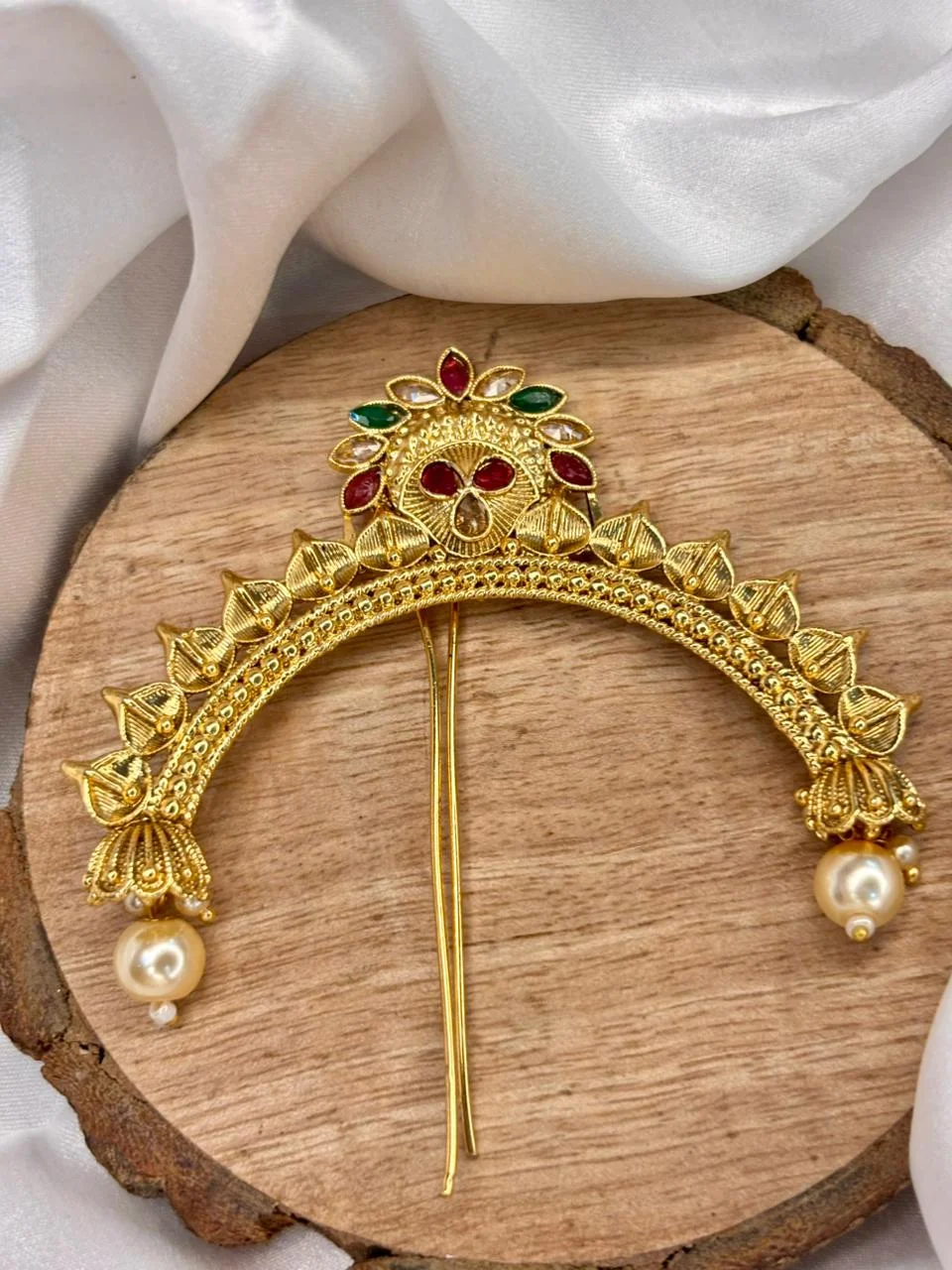
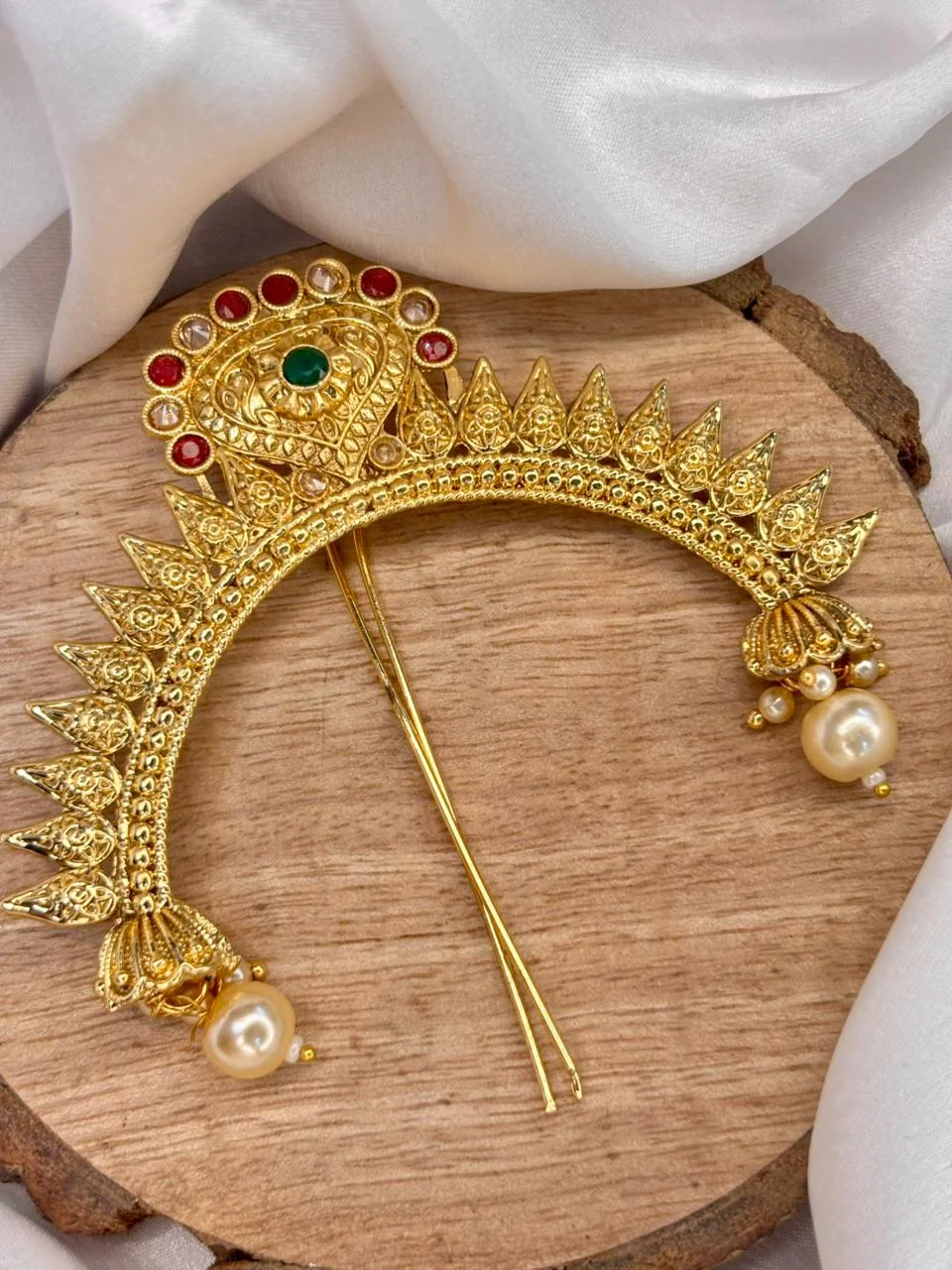
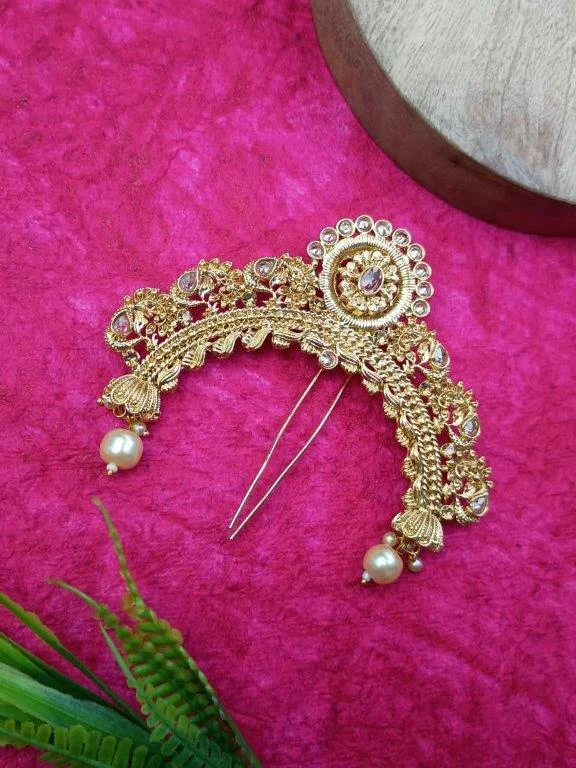
The arch on this ambada pin is a smooth horseshoe, and the whole of it is filled with filigree — fine twisted wire laid into scrolls and curls — with rows of granulation, tiny beads of metal soldered along the borders, framing it on both edges. At the upper end sits the piece's anchor: a large round rosette, raised above the arch on its own setting, with a stone at its centre inside a ring of petals.
Filigree and granulation are the two oldest decorative techniques in Indian goldwork and they do opposite things. Filigree opens a surface up, so light passes through the gaps and the metal looks lighter than it is. Granulation closes it down into rows of tiny bright points. Using both on one piece is what gives an arch like this its depth at a glance, and it is why a plain stamped arch of the same size looks cheap next to it.
Two colourways change the stones along the arch and in the rosette: Diamond White, clear throughout and the most versatile, and Red, ruby-red and the more festive of the two. The red pieces vary slightly between batches — some carry a little green among the reds for the traditional ruby-and-emerald effect — so we confirm exactly which you are getting before dispatch. From each tip of the arch hangs a white pearl in a fluted gold cap, and those two drops are the only moving parts.
An ambada pin is worn around the bun rather than through it. The decorated arch lies on the outside of the coil, following its curve, and a single straight prong behind the arch slides into the hair and anchors it. That is a different fitting from a two-prong juda fork, and a different look: a fork shows a motif sitting on top of the bun, while an arch frames the whole bun and outlines it. It is the standard Maharashtrian way of finishing a low bun, worn with a nauvari saree, and it has stayed in use because nothing else makes a plain coil of hair look finished quite so quickly.
To wear it, make the bun first and secure it with pins or a band. Hold the arch against the lower edge of the coil so the curve matches, then push the straight prong in under the bun and up into the hair behind it. The arch should sit against the hair, not stand away from it. If it tips forward, the bun is too small for the arch — a slightly larger, looser coil holds it better than a tight small one.
The piece measures about 3 inches across the arch, which suits a small to medium bun. Wear it with the hair pulled back smooth and a centre or side parting, and keep the earrings modest — the arch already draws a line around the back of the head. It works with a saree, a lehenga or a plain kurta, and it is one of the most useful pieces to own for weddings, because it dresses up an outfit without needing a second thought.
Base metal is copper with a gold-tone finish. Keep it out of hairspray, which settles as a slightly acidic film and dulls plating faster than ordinary wear ever does — spray first, let it dry, then pin, and wipe with a dry cloth afterwards.
| Stone Type | Kundan, Pearl |
| Weight (grams) | 0.00 |
| Colour/Finish | White |
| Occasion | Wedding, Festival, Traditional |
| Gender | women |
| SKU/Product Code | KEYU-NAA2045 |