| Weight (g) | 0.00 |
| Colour | Silver |
| Occasion | Daily Wear, Casual, Office |
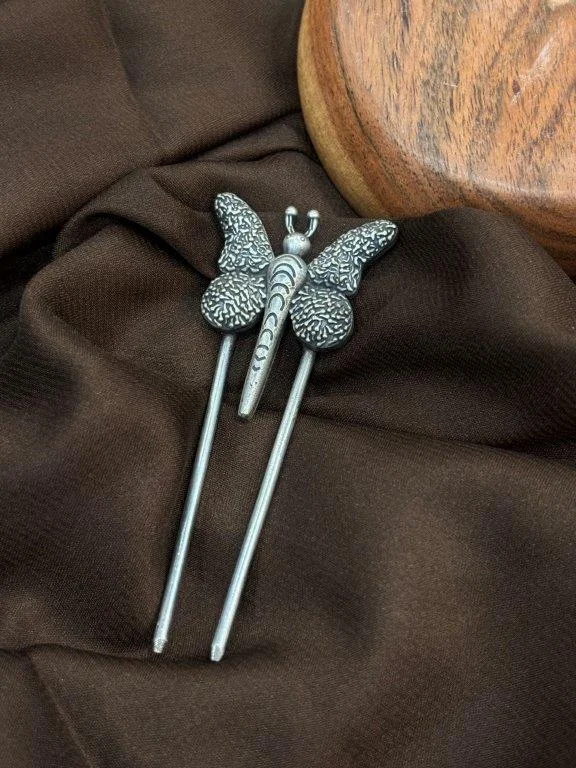
A butterfly sits at the head of this pin with its wings spread flat, each one filled edge to edge with a fine stippled texture so that the surface breaks light up instead of reflecting it in one sheet. The body is segmented and ridged, and two thin antennae rise and curl at the tips. All of it is oxidised — the metal darkened and then polished back, so the blackening stays in the texture while the raised surfaces come up bright.
That contrast is the whole design. A butterfly cast in smooth polished metal would read as a flat silhouette; textured and oxidised, the wings have depth and the piece looks hand-finished rather than stamped. It is the same principle behind all oxidised tribal silver, applied to a motif that is not traditional at all.
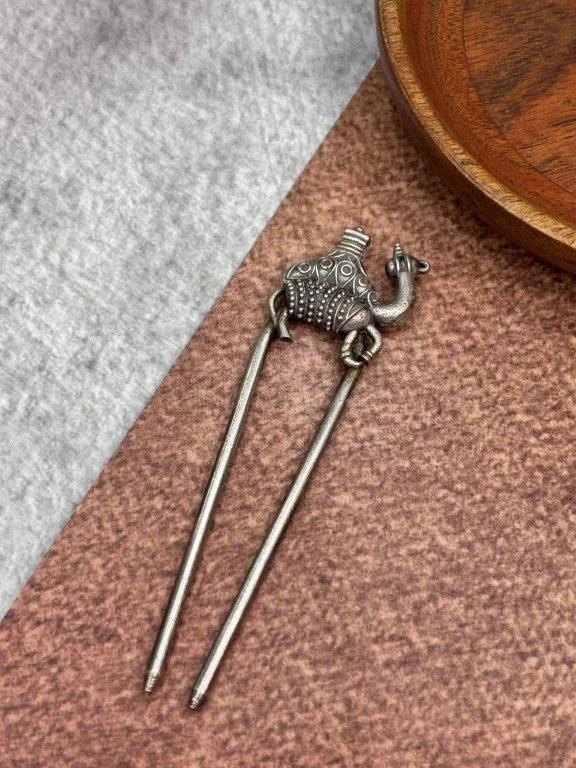
And that is worth saying plainly, because it is the reason to choose this one. Almost every other hair ornament in this range is rooted in a specific tradition — a temple animal, a Maharashtrian arch, a Rajasthani charm. A butterfly belongs to none of them. It reads as oxidised Indian silver in its finish and as entirely contemporary in its subject, which makes it the pin to wear with a plain cotton kurta, with jeans, or to an office, where a Nandi bull would be a statement you may not want to make before a meeting.
There are no stones. The two prongs are plain, smooth and slightly tapered, and they are what holds the hair: pushed through the coil of a bun they grip by friction, with no clip, band or spring to fail. Push the pin in at the edge of the bun angled slightly downwards, let the prongs pass under the coil, and bring the tips back out the other side so they rest against the head. Straight in, it works loose within the hour; threaded through, it holds all day.
It also works in a thick plait rather than a bun, slid in across the braid near the top, which is how these are often worn day to day.
Because there is nothing projecting and nothing hanging, it is also the easiest hair ornament here to actually live with. It does not catch on a dupatta pulled over the head, it does not snag a jacket collar, and it survives being dropped into a bag without a pouch. Those sound like small things until you have ruined a stone-set pin in a handbag.
Two of these worn together, crossed through the same bun from opposite sides, hold considerably more hair than one — which is the traditional way to use forks in very long or very heavy hair, and looks deliberate rather than improvised.
Base metal is brass with an oxidised silver-tone finish. Keep it away from hairspray, which settles as a slightly acidic film and dulls a plated finish faster than ordinary wear ever will. Spray first, let it dry, then pin.
This is brass given an oxidised, antique-silver finish rather than solid silver. The metal is darkened and the raised surfaces are then polished back, so the blackening stays in the recesses while the high points stay bright. That contrast is the whole point of oxidised work — it is what makes every engraved line and pierced opening read separately instead of dissolving into one shiny surface, and it means small variations between pieces are normal rather than faults.
Put this on after perfume, hairspray and hand cream, and take it off before washing, swimming or sleeping. Wipe with a dry soft cloth and use a dry soft brush around the stone settings and between any pearls, where a cloth cannot reach. Store it in a zip-lock pouch — which is what the supplier themselves advise, and the single most effective thing for a plated piece, because it keeps humid air off the metal. Never use silver polish, dip cleaners or an ultrasonic cleaner.
| Weight (grams) | 0.00 |
| Colour/Finish | Silver |
| Occasion | Daily Wear, Casual, Office |
| Gender | women |
| SKU/Product Code | KEYU-NAA937 |