| Stone Type | Glass & CZ Stones |
| Weight (g) | 0.00 |
| Colour | Ruby |
| Occasion | Festival, Traditional, Daily Wear |
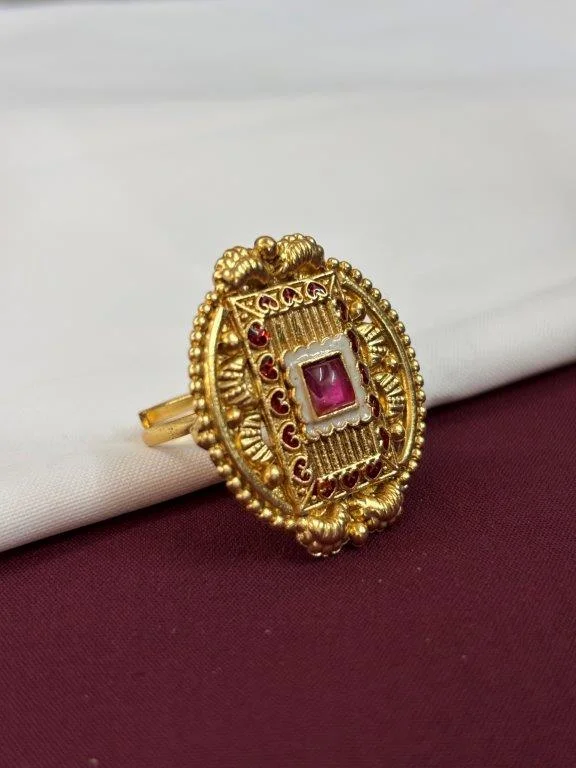
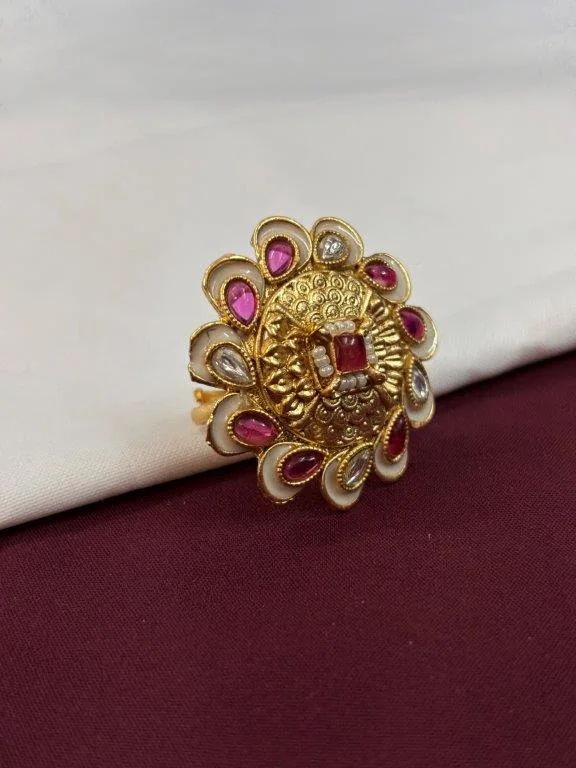
A round medallion, almost flat, with its surface divided into four quarters by raised bands that meet at the centre. Each quarter is filled with dense scrollwork — tight curls and leaf forms pressed into the metal — and at the point where the four bands cross sits a single small square stone in a plain bezel. A fine beaded rim runs round the whole edge.
Dividing a circle into four and filling each quarter with the same pattern is one of the oldest ways of organising ornament, and it is everywhere in Indian metalwork: on the backs of mirrors, on the lids of kumkum boxes, on temple door bosses. It works because the eye reads the structure immediately and then has somewhere to wander, which is why a busy surface like this never looks chaotic.
The stones are glass and cubic zirconia rather than gemstones, hand-set into closed metal bezels. A closed back holds the stone against the knocks a ring takes, and the dark oxidised rim around it keeps the colour reading clearly instead of washing out against the metal.
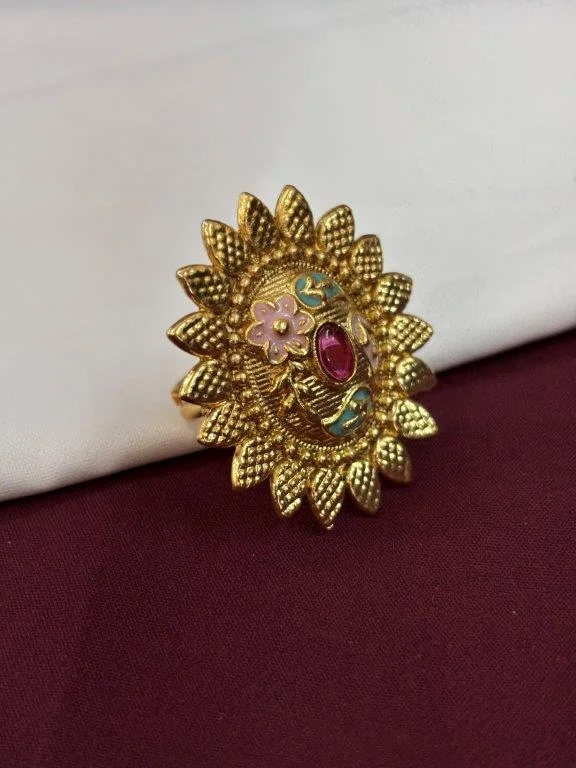
Three colourways are stocked, and only the small square stone changes: Ruby, White and Green. As with the sunflower ring here, the stone is a full stop rather than the subject — this is an oxidised silver ring that happens to have a coloured centre.
The piece is brass, plated and then oxidised — chemically darkened and polished back, so the blackening stays in the recesses while the raised surfaces come up bright. That contrast is the whole point of the finish: it is what makes shallow carving read as deep carving, and it is why an oxidised ring at this price can look like worked silver from across a table.
This ring is adjustable. The band is not a closed circle — it is a tapered strip coiled so the two ends overlap behind the finger, and you open or close it by a few millimetres with your fingers. In practice that covers most adult sizes, roughly a UK J to a UK S, which is why almost all Indian fashion rings are made this way: nobody has to know their ring size, and the same ring still fits when knuckles swell in summer.
Adjust it off the finger, not on it, and move it gradually. Opening and closing the same band repeatedly is what eventually tires the metal, so set it once to your finger and leave it there.
Because it is flat and round with a beaded rather than a pointed rim, this is genuinely one of the more practical rings in the range. It does not catch badly, it sits close, and at this price it is an easy ring to wear every day and not worry about.
The scrollwork is fine and deeply oxidised, so a dry soft brush occasionally is worth the trouble — dust in the curls is what makes this kind of surface go flat and grey.
Rings take more punishment than any other piece of jewellery because hands do the work. The things that actually shorten a plated ring's life are water, soap, hand sanitiser, perfume and cooking oil, in roughly that order. The habit worth building is simple: the ring goes on last when you are dressing and comes off first when you are washing up, bathing, cooking or swimming.
Clean it with a dry soft cloth only. Never use a silver dip or a polish — a dip strips an oxidised finish completely and will take gold plating with it, and a polish wears plating thin at exactly the high points you want to keep bright. Store it dry and on its own, because rings scratch each other in a shared box.
| Stone Type | Glass & CZ Stones |
| Weight (grams) | 0.00 |
| Colour/Finish | Ruby |
| Occasion | Festival, Traditional, Daily Wear |
| Gender | women |
| SKU/Product Code | KEYU-NAA3087 |