↔ Drag or swipe · Double-click to fullscreen
| Metal | Brass |
| Stone Type | No Stone |
| Weight (g) | 13.00 |
| Colour | Silver |
| Occasion | Festival |
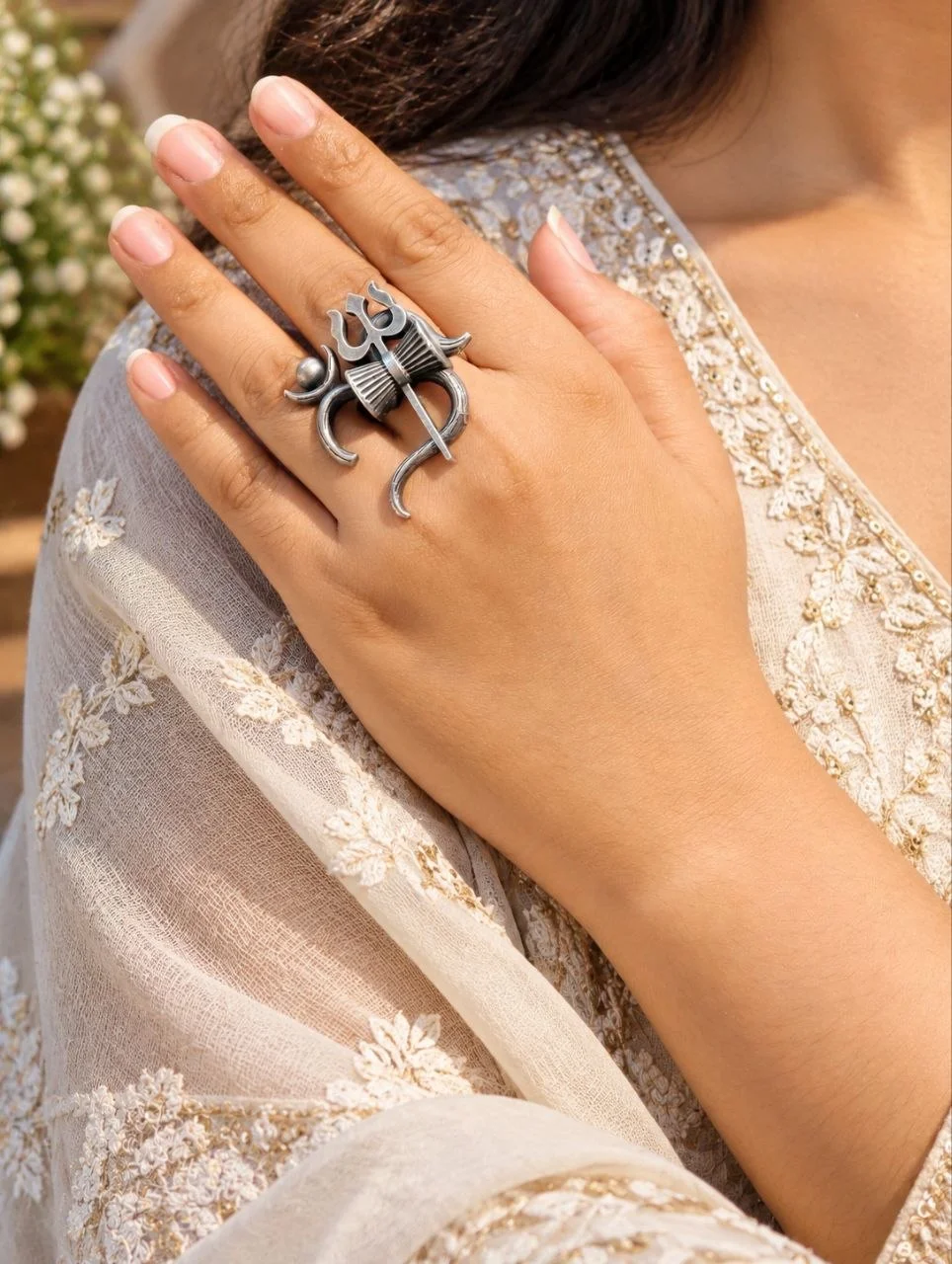
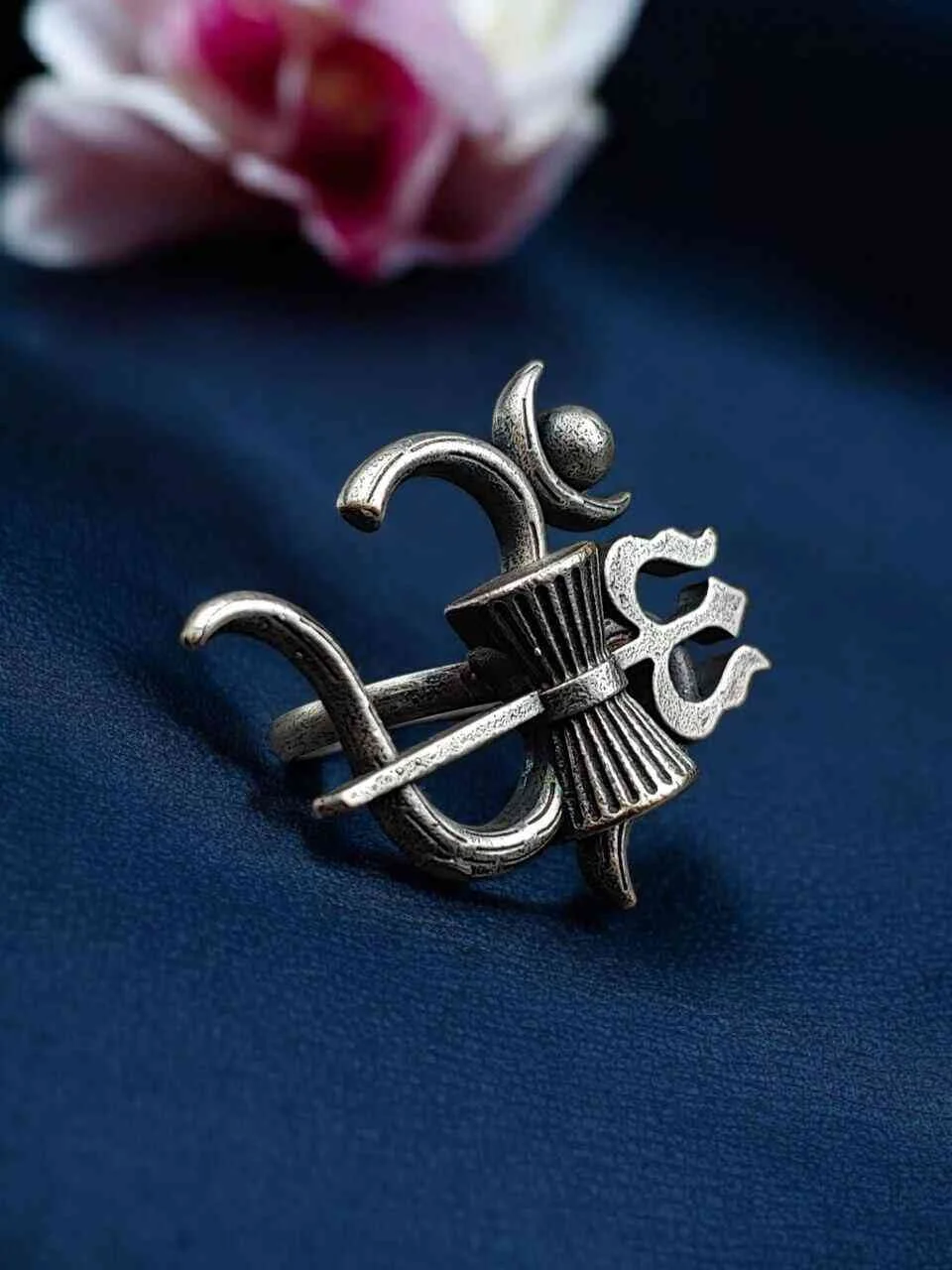
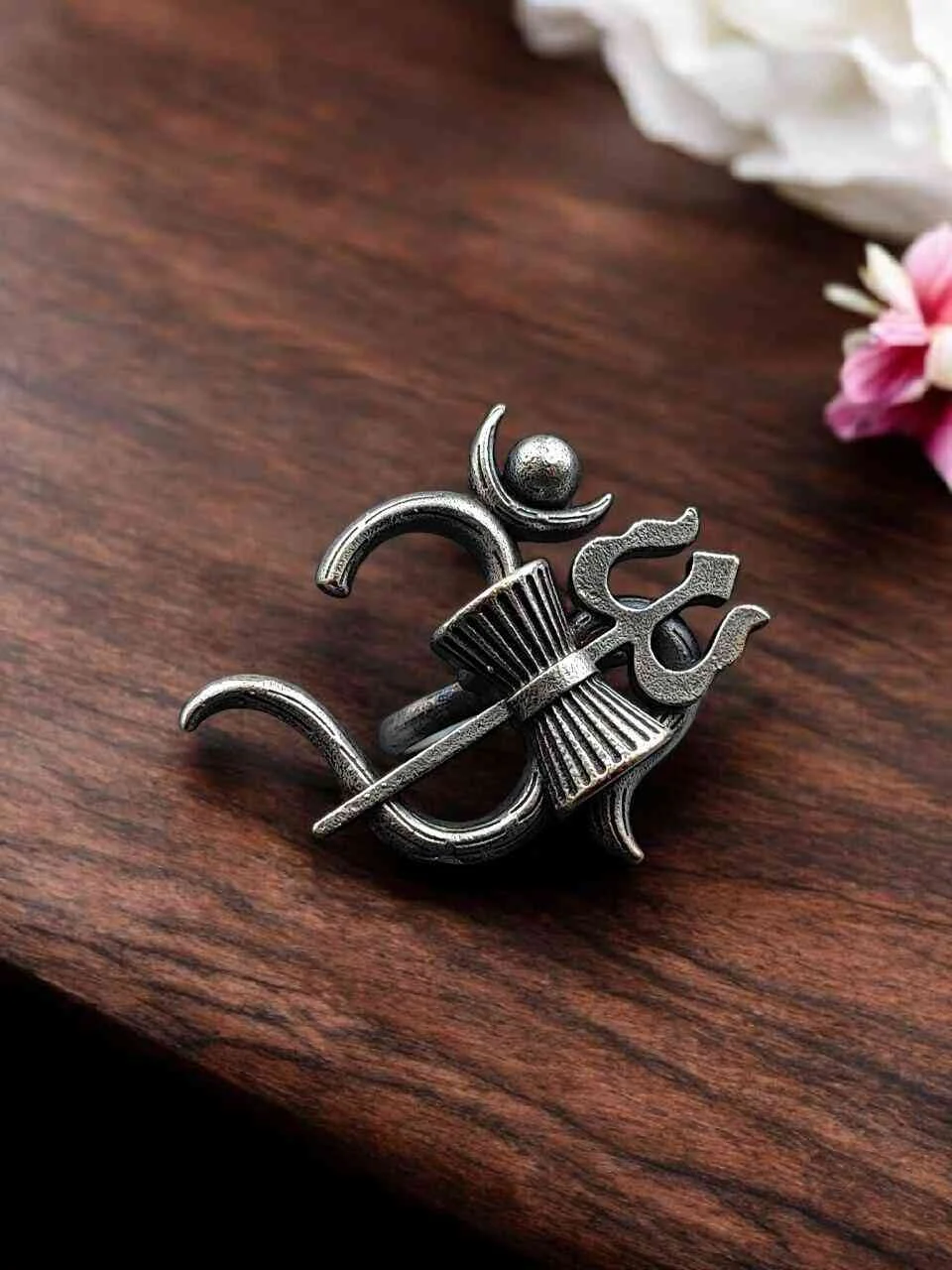
The damaru — Shiva's hourglass drum — sits across the finger with a trishul crossing it diagonally, a crescent moon curving beneath, and a small round bead at one side. Oxidised antique silver throughout, on an adjustable band.
There is no figure on this ring. Instead it carries the objects by which Shiva is identified — the drum, the trident, the moon — which is an older and more widespread convention in Indian devotional art than portraiture. A deity shown by their attributes can be recognised instantly without any face needing to be carved, and it lets a design work at a size where a face would be unreadable.
The damaru is the two-headed drum Shiva holds in his upper hand; its beat is said to be the sound from which creation begins, and its hourglass shape — two triangles meeting at a point — is read as the meeting of the masculine and feminine. The trishul is his trident, its three points standing for creation, preservation and dissolution. The crescent moon sits in his hair, marking him as the one who holds time itself.
These are shapes rather than textures — a drum, a shaft, a curve — and they are read by outline. Bright polished metal breaks an outline with highlights running across it; blackening the recesses keeps each object distinct from the one behind it, so the damaru stays a drum and the trishul stays a trident even in a photograph.
Adjustable at the back, so no ring size is needed. The design has a clear right way up, so sit it upright rather than letting it turn.
Wear it alone with the hand bare. It suits handloom, cotton and traditional dress, works equally for men and women, and is a natural choice for Mahashivratri, Shravan and temple visits.
Mahashivratri, Shravan Mondays, temple visits, festivals and daily wear.
Light, though the trishul shaft stands proud of the finger, so take it off before anything that needs a firm grip.
This is brass given an oxidised, antique-silver finish rather than solid silver. The metal is deliberately darkened and then the raised surfaces are polished back, so the blackening stays in the recesses while the high points stay bright. That contrast is the entire point of oxidised work — it is what makes every engraved line, pierced opening and raised edge read separately instead of dissolving into one shiny surface. It also means the finish is not uniform by design, and small variations between pieces are normal rather than faults.
Put it on after perfume, hand cream and sanitiser, and take it off before washing up, swimming or sleeping. Wipe with a dry soft cloth only. Do not use silver polish, dip cleaners or toothpaste — they strip the blackening out of the recesses, which is the one kind of damage that cannot be undone on an oxidised piece. Store it dry in a pouch, away from other rings that could scratch it.
Type: Adjustable devotional ring. Metal: Brass. Finish: Oxidised antique silver tone. Work: Damaru crossed by a trishul with a crescent moon. Fit: Adjustable, open band.
| Metal | Brass |
| Stone Type | No Stone |
| Weight (grams) | 13.00 |
| Colour/Finish | Silver |
| Occasion | Festival |
| Gender | men |
| SKU/Product Code | KEYU340T30675 |