| Weight (g) | 0.00 |
| Colour | Silver |
| Occasion | Festival, Traditional, Daily Wear |
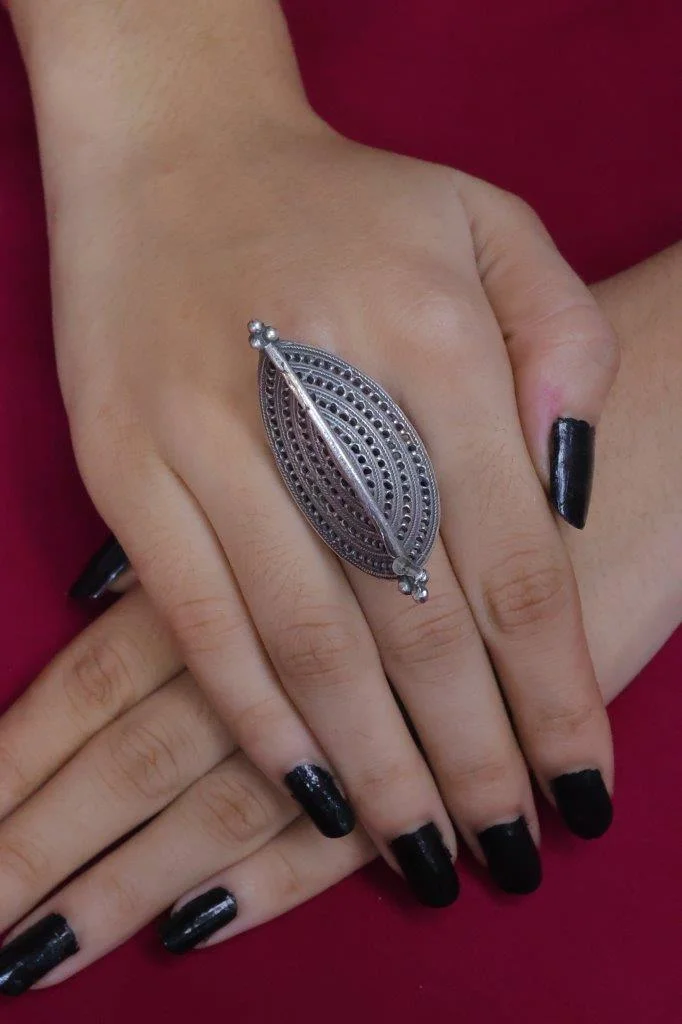
A long pointed leaf, rounded in section and tapering to a point at both ends, worn lengthwise along the finger. Where the bud ring in this range is cut into deep flutes, this one is covered in fine diagonal hatching — dozens of short parallel lines scored across the whole surface, close enough that from a step away they read as texture rather than as individual marks.
Hatching is the oldest way of making metal look like something other than metal. Cut across a curved surface it catches light at every angle at once, so instead of one broad highlight sliding over a smooth dome, you get a soft even shimmer that does not move much as the hand turns. The effect is closer to woven silk or a seed pod than to polished silver, which is exactly what the maker is after.
The piece is brass, plated and then oxidised — chemically darkened and polished back, so the blackening stays in the recesses while the raised surfaces come up bright. That contrast is the whole point of the finish: it is what makes shallow carving read as deep carving, and it is why an oxidised ring at this price can look like worked silver from across a table.
Compared with the fluted bud, this ring is the quieter of the two elongated shapes. The flutes on that one throw hard highlights; the hatching here diffuses them. If you want the long-finger line without the ring shouting, this is the one to take.
This ring is adjustable. The band is not a closed circle — it is a tapered strip coiled so the two ends overlap behind the finger, and you open or close it by a few millimetres with your fingers. In practice that covers most adult sizes, roughly a UK J to a UK S, which is why almost all Indian fashion rings are made this way: nobody has to know their ring size, and the same ring still fits when knuckles swell in summer.
Adjust it off the finger, not on it, and move it gradually. Opening and closing the same band repeatedly is what eventually tires the metal, so set it once to your finger and leave it there.
Wear it on the middle or index finger, pointed end towards the nail, and on its own. A leaf is about as neutral a motif as Indian metalwork offers — it belongs to no particular region and carries no particular meaning, so it will not look out of place at an office, a puja or a dinner.
One practical note: hatched surfaces hold dust in a way smooth ones do not. A dry soft brush once in a while keeps the texture crisp, and takes ten seconds.
Rings take more punishment than any other piece of jewellery because hands do the work. The things that actually shorten a plated ring's life are water, soap, hand sanitiser, perfume and cooking oil, in roughly that order. The habit worth building is simple: the ring goes on last when you are dressing and comes off first when you are washing up, bathing, cooking or swimming.
Clean it with a dry soft cloth only. Never use a silver dip or a polish — a dip strips an oxidised finish completely and will take gold plating with it, and a polish wears plating thin at exactly the high points you want to keep bright. Store it dry and on its own, because rings scratch each other in a shared box.
| Weight (grams) | 0.00 |
| Colour/Finish | Silver |
| Occasion | Festival, Traditional, Daily Wear |
| Gender | women |
| SKU/Product Code | KEYU-NAA3146 |