🚚 Free shipping on orders above ₹999 | Navratri Offer Available  |  🚚 Free shipping on orders above ₹999 | Navratri Offer Available
Intl · USD
All Jewellery
🛍
Your Cart
💛 2,100+ happy customers this week
We are also on Amazon, Flipkart & Meesho GSTIN 05AFBPL0082M1ZK Verified seller on Amazon.in Listed brand on Flipkart Direct price, no marketplace commission Secure prepaid payments Free shipping above ₹999 Damaged in transit? 3-day claim window Dispatched from India WhatsApp support, Mon–Sat We are also on Amazon, Flipkart & Meesho GSTIN 05AFBPL0082M1ZK Verified seller on Amazon.in Listed brand on Flipkart Direct price, no marketplace commission Secure prepaid payments Free shipping above ₹999 Damaged in transit? 3-day claim window Dispatched from India WhatsApp support, Mon–Sat
Home / Shop / Rings / Emerald Cut Cocktail Ring with Pave Border

Emerald Cut Cocktail Ring with Pave Border

$23 $39 41% OFF
Shown in USD · Paid securely via PayPal · Shipped from India 🇮🇳
Availability on request
Choose Color
Pink — 25 in stock
Qty
Selling fast. Demand for this piece is very high and stock moves quickly, so please check with us on WhatsApp whether it is available before ordering.
Ask availability
Check delivery time
Secure Payment
Worldwide shipping · 5–12 working days
We also sell on Keyura is a GST-registered business (GSTIN 05AFBPL0082M1ZK) and a verified marketplace seller. Marketplaces charge a commission on every sale and it is built into the price you pay there — ordering from keyura.in skips it, so the same jewellery costs you less here.
Stone TypeGlass & CZ Stones
Weight (g)0.00
ColourPink
OccasionWedding, Festival, Party

Product Description

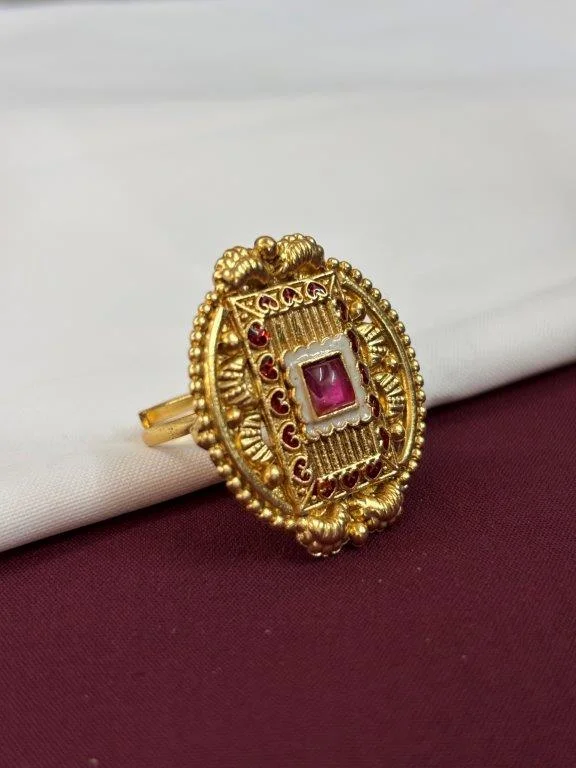
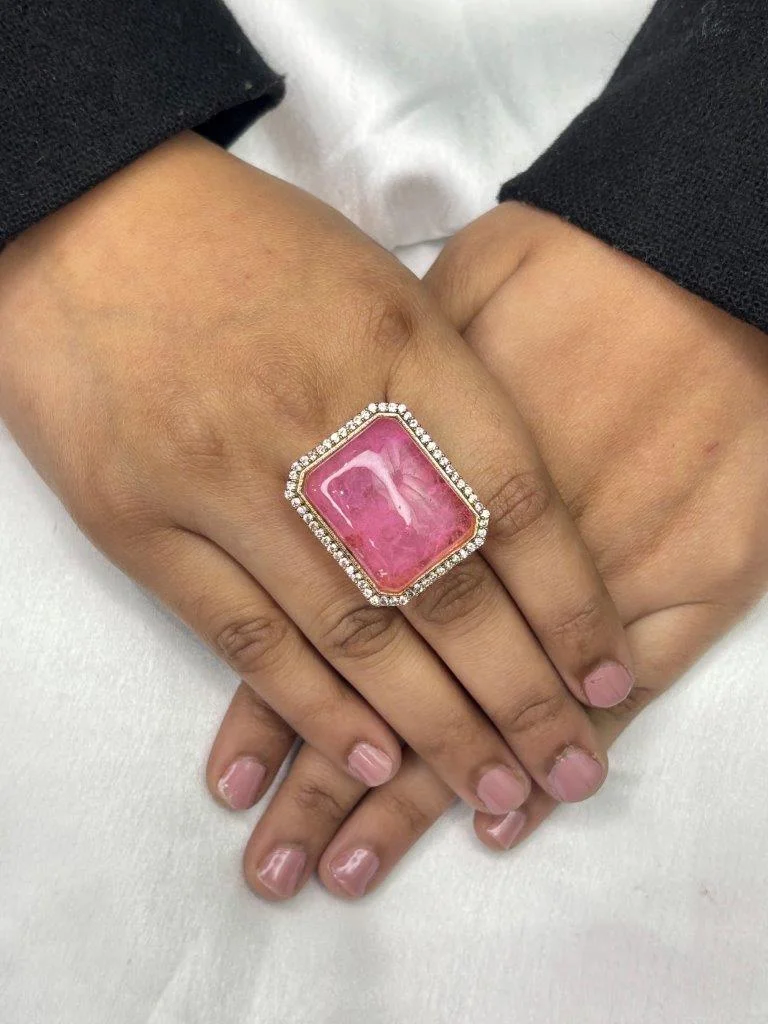
One big stone, framed properly. The centre is a large rectangle cut with stepped facets running parallel to its edges and the corners clipped off — the shape jewellers call an emerald cut, because it was developed for emeralds, which crack if you put a sharp point on them. Around it runs a close-set border of small clear stones, and the band is plain gold tone so nothing competes.

An emerald cut behaves differently from the brilliant cuts used in most costume jewellery. A brilliant is engineered to scatter light into white sparkle; an emerald cut has fewer, larger facets arranged in steps, so instead of sparkling it flashes in broad planes and shows the colour of the stone much more honestly. On a stone this size that is the right choice — you want to see the colour, not a glitter.

The small stones around the edge are doing a specific job. A large stone sitting alone on a plain band looks stranded; a border of tiny stones gives the eye a transition from metal to colour and makes the centre stone read as larger than it is. Every serious cocktail ring ever made uses this trick.

Materials

A word on what this style actually is. Kundan is the technique of setting a stone without claws: the stone is laid into a recess and then strips of pure, very soft gold are pressed in around it until the metal grips it. It is the oldest setting method in India, it predates the use of prongs by centuries, and it is why Mughal-period jewellery has that characteristic flat gold rim around every stone. What you are buying here is the look of that technique rendered in plated brass with glass and cubic zirconia, which is what the whole Indian imitation-jewellery trade is built on.

Shades and stock

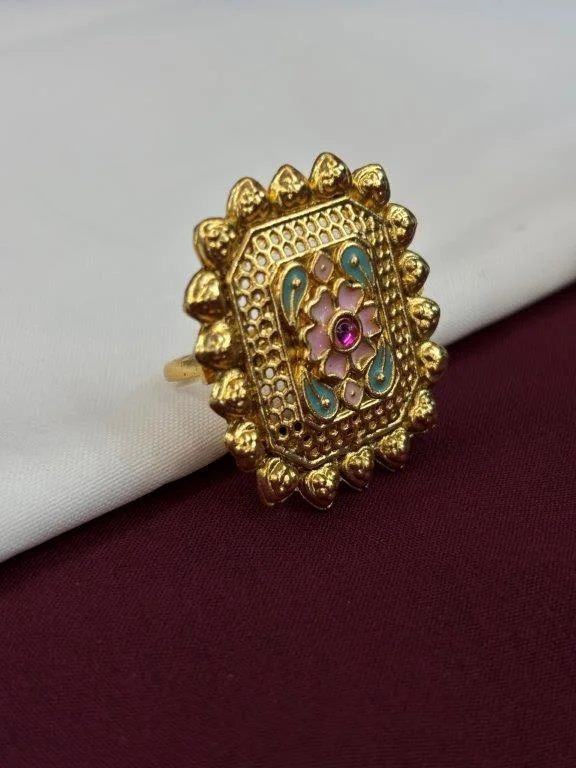
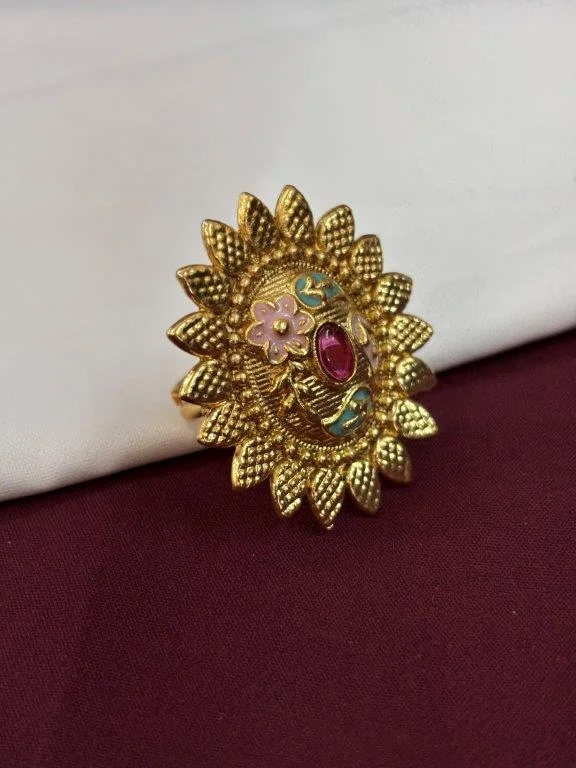
Three colourways are stocked. Red is the best-stocked and the most classic against gold. Pink is the softest and the one in the main photograph. Purple is the most unusual and the one that reads as a semi-precious stone rather than a ruby substitute.

The piece is brass with a gold-tone plating. It is not gold and is not sold as gold — what it gives you is the warm colour and the weight of a much more expensive ring, in something you can wear to a wedding without thinking about it, and replace without regret if it is lost.

Fit

This ring is adjustable. The band is not a closed circle — it is a tapered strip coiled so the two ends overlap behind the finger, and you open or close it by a few millimetres with your fingers. In practice that covers most adult sizes, roughly a UK J to a UK S, which is why almost all Indian fashion rings are made this way: nobody has to know their ring size, and the same ring still fits when knuckles swell in summer.

A closer look

Adjust it off the finger, not on it, and move it gradually. Opening and closing the same band repeatedly is what eventually tires the metal, so set it once to your finger and leave it there.

How it wears

This is the most expensive ring in the range and it looks like it from across a room. It is a cocktail ring in the proper sense — one large stone, worn alone, on an evening when the hand is going to be seen. Wear it on the index or middle finger with no other rings on that hand.

Care

Rings take more punishment than any other piece of jewellery because hands do the work. The things that actually shorten a plated ring's life are water, soap, hand sanitiser, perfume and cooking oil, in roughly that order. The habit worth building is simple: the ring goes on last when you are dressing and comes off first when you are washing up, bathing, cooking or swimming.

Clean it with a dry soft cloth only. Never use a silver dip or a polish — a dip strips an oxidised finish completely and will take gold plating with it, and a polish wears plating thin at exactly the high points you want to keep bright. Store it dry and on its own, because rings scratch each other in a shared box.

Product Specifications

Stone TypeGlass & CZ Stones
Weight (grams)0.00
Colour/FinishPink
OccasionWedding, Festival, Party
Genderwomen
SKU/Product CodeKEYU-NAA1423

Customer Reviews

No reviews yet. Be the first!

Frequently Asked Questions

A rectangular cut with stepped facets running parallel to the edges and the corners clipped off. It was developed for emeralds, which crack if you put a sharp point on them.
By design. A brilliant cut scatters light into white sparkle; an emerald cut has fewer, larger facets in steps, so it flashes in broad planes and shows the colour far more honestly.
A large stone alone on a plain band looks stranded. A border gives the eye a transition from metal to colour and makes the centre stone read as larger. Every proper cocktail ring uses it.
Red against gold. Pink is the softest and is the one photographed; Purple reads as a semi-precious stone rather than a ruby substitute.
No. It is a cocktail ring in the proper sense — one large stone, worn alone on the index or middle finger.
Yes, and it looks it from across a room. The size of the centre stone and the hand-set border are where the money goes.
It is an evening ring rather than a daily one. The setting stands proud and the border catches on knitwear.
Almost certainly — the band is an open adjustable coil rather than a fixed size.
No. It is brass with a gold-tone plating, and it is not sold as gold. What it gives you is the colour and the weight of a far more expensive ring in something you can wear to a wedding without worrying about it.
That depends almost entirely on what it meets. Water, soap, hand sanitiser, perfume and cooking oil are what wear plating thin, so putting the ring on last and taking it off first is the whole of the maintenance.
No — glass and cubic zirconia, hand-set in the Indian manner. They are chosen for colour and for how they sit against gold tone rather than for hardness.
A dry soft cloth only. Never a dip cleaner or a metal polish: a dip will strip plating outright and polish wears it thin at exactly the raised points you want to keep bright.
Yes. The band is an open coil rather than a closed circle, so you widen or narrow it by a few millimetres with your fingers. It fits most adult sizes, roughly a UK J to a UK S.
Off the finger, gradually. Opening and closing the same band repeatedly is what tires the metal, so set it once to your finger and leave it there.
Better not. Water, soap, hand sanitiser, perfume and cooking oil are what shorten a plated ring's life. Put it on last when dressing and take it off first when washing up or bathing.
A dry soft cloth only. Never a silver dip or polish — a dip strips an oxidised finish completely and takes gold plating with it, and polish wears plating thin at the high points.