| Stone Type | No Stone |
| Weight (g) | 12.00 |
| Colour | Silver |
| Occasion | Festival |
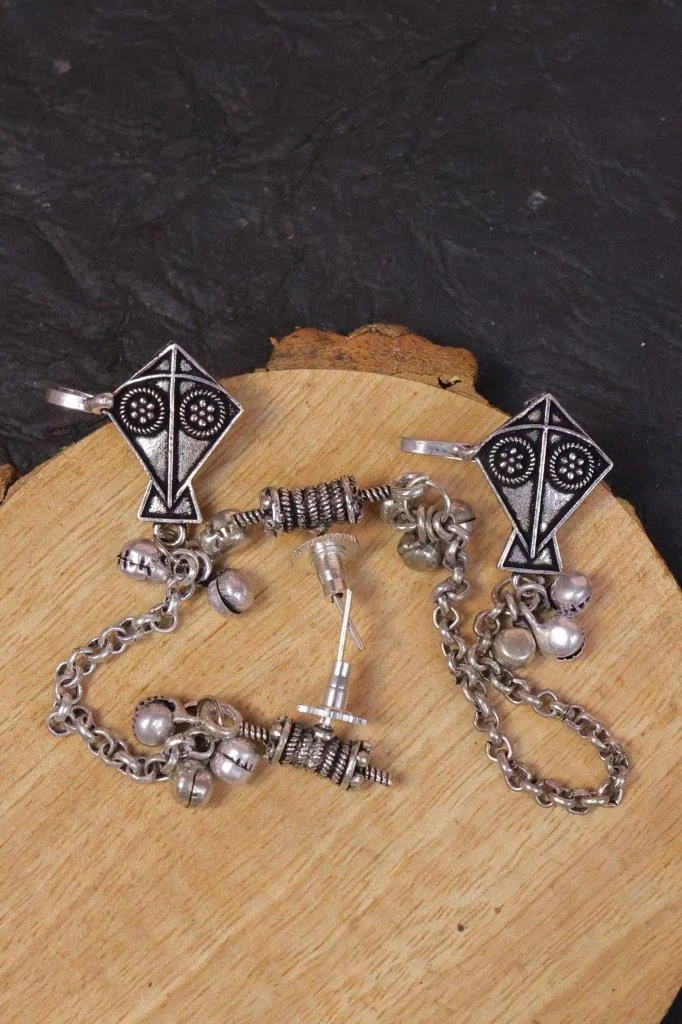
A diamond shaped kite sits at the lobe, its cross struts picked out in raised silver, and from its lower corner trails a fine chain strung with tiny ghungroo bells — exactly the way a real kite carries its tail.
Available in Silver — the oxidised antique finish, stoneless throughout.
Jewellery is rarely playful without becoming childish, and this pair manages it. The kite is instantly readable, but it is rendered in proper oxidised silver with clean geometric lines rather than as a cartoon, so it keeps the character of traditional craft while being genuinely cheerful.
The trailing chain is what completes the idea. Rather than a symmetrical fringe, the tail hangs from one corner and swings loosely, which gives the earring an asymmetry that is unusual and immediately catches the eye.
Kites carry real meaning in India, tied to Makar Sankranti and Uttarayan, when the sky fills with them across Gujarat, Rajasthan and much of the north. A kite earring is an obvious choice for that festival, but the shape is simple enough that it does not look seasonal the rest of the year — it reads as a clean geometric diamond to anyone who does not make the connection.
Small ghungroo bells are threaded along the tail at intervals. They chime very softly as you move, and being solid silver rather than hollow they catch light as small bright points along the chain.
A hook fitting carries a very light earring. Because the tail is a loose chain rather than a rigid drop, it moves constantly and never feels heavy.
Plain cotton kurtas, handloom, jeans and a shirt. They are a good everyday pair for someone who likes silver but finds most traditional designs too formal. Tie your hair back so the tail is visible, and keep other jewellery minimal — the asymmetry is the point and it needs space.
Almost all traditional earrings are symmetrical, left and right identical and each one balanced within itself. Breaking that is riskier than it sounds, because the eye notices imbalance immediately and reads it either as deliberate or as a mistake. A trailing tail from one corner works because the reference is obvious: everyone knows a kite has a tail, and knows which way it hangs. The asymmetry is explained by the subject rather than imposed on it, which is why these read as designed rather than as an error in manufacture.
Store them in a zip lock pouch so the chain tails do not tangle. Put them on after perfume, wipe with a dry soft cloth and keep them out of water.
| Stone Type | No Stone |
| Weight (grams) | 12.00 |
| Colour/Finish | Silver |
| Occasion | Festival |
| Gender | women |
| SKU/Product Code | KEYU-NAA2943 |