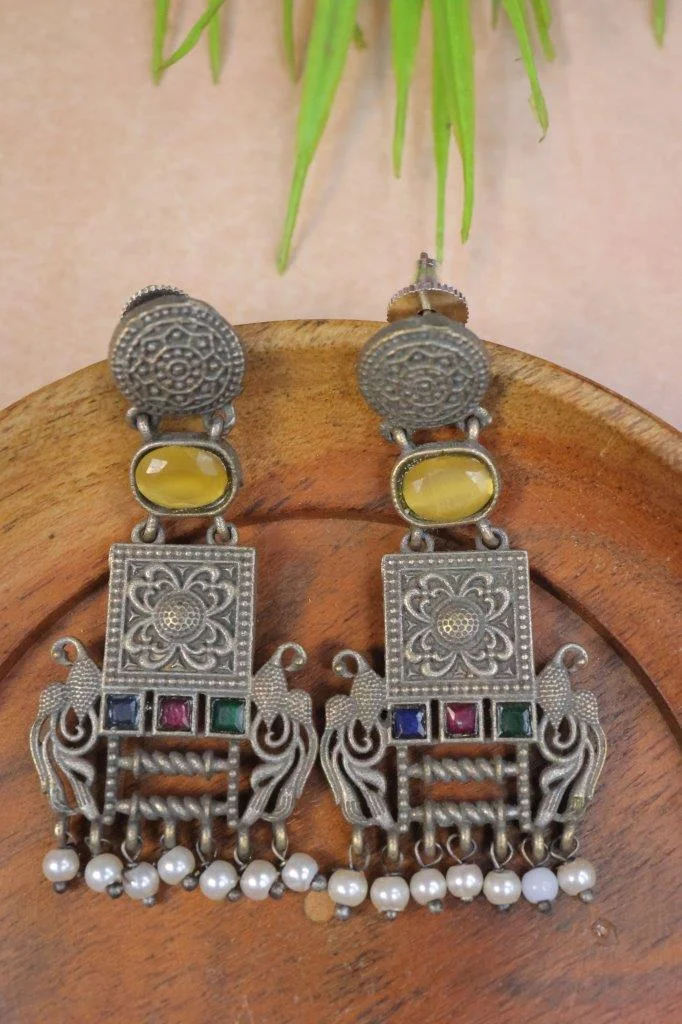
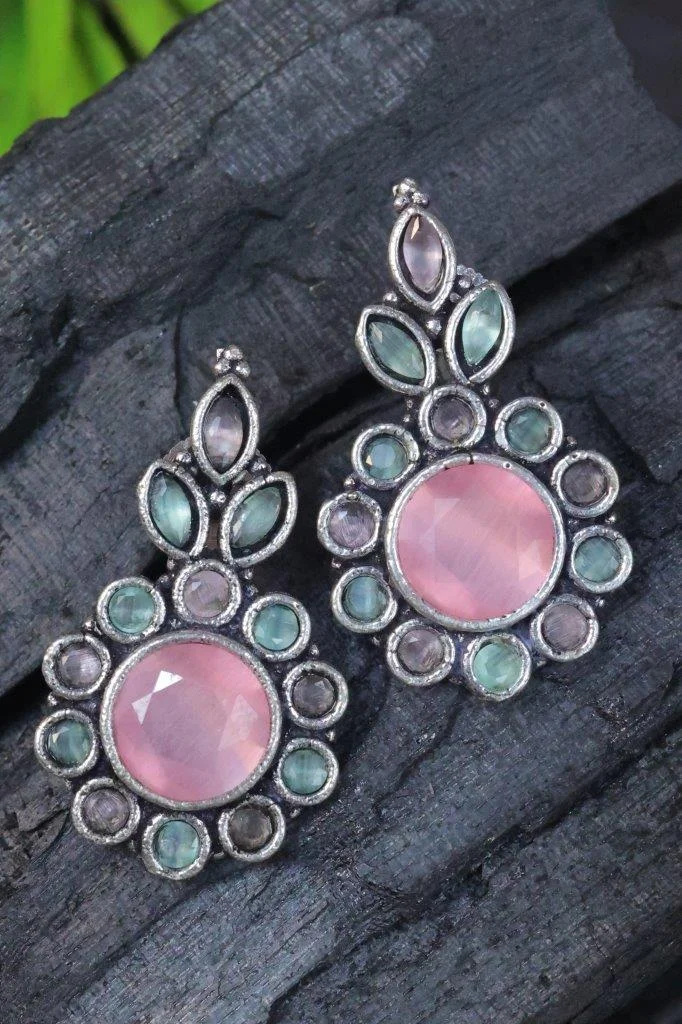
| Stone Type | Cubic Zirconia, Pearl |
| Weight (g) | 4.00 |
| Colour | Multi Color |
| Occasion | Wedding, Festival, Traditional |
At the centre of this bugadi is a single stone cut in the kairi shape — the raw-mango outline that runs through Indian design on everything from paisley borders to temple carving. It is a pale yellow-green, lighter than the stones around it, and that difference in tone is what makes the shape readable. Had it been another pink stone the outline would have vanished into the setting; because it is paler, the mango shape reads clearly even at the small scale a bugadi works at.
Around the upper edge of the stone sits an arc of small magenta pink stones, rising to a point where the hook joins, so the top of the piece comes to a peak rather than a curve. Below and to each side, round white pearls open outwards in a wide fan, with small gold beads set between them along the outer rim. Two faceted drops, one red and one green, hang on short links at the base and swing a little as you move.
Fit is the thing people most often get wrong when buying their first bugadi, so it is worth being direct about it. This is not an ear cuff. A cuff grips the edge of the ear by spring tension and can be worn without any piercing at all; a bugadi passes a hook through a helix piercing and hangs from it. The two look similar in photographs and behave completely differently on the ear. If your upper ear is not pierced, a cuff is what you want. If it is, a bugadi will sit more securely than any cuff does and will not slide down the helix over the course of an evening.
The fan shape is what gives this one its presence. Spreading outwards rather than hanging down means the piece reads from the front at roughly the same width as a small jhumka, while adding almost no length. On the ear it fills the upper curve and stops, so it does not interfere with a lobe earring or with glasses.
At about 1.1 inches it is on the larger side of this range. The palette — pale centre, magenta, white and gold — is warm but not loud, which makes it easier to wear with a printed outfit than the strong red-and-green pieces. Wear it as a pair with the hair off the face, and keep the lobes plain so the fan has room to read.
A word on how a bugadi settles. When you first thread the hook through, the piece hangs loosely and looks as though it is about to swing. Within a few seconds the weight of the fan tips it forward and the upper edge comes to rest against the curve of the helix, and from then on it stays put. That forward lean is what makes a bugadi photograph from the front rather than disappearing edge-on, and it is why these pieces are built front-heavy on purpose rather than balanced.
Base metal is brass with a gold-tone plating. The stones are cubic zirconia and the pearls are shell-style faux pearls.
This is brass with a gold-tone plating rather than solid gold, which keeps the price where it is and the weight low enough to wear comfortably. Plating is a surface rather than a bulk property, so how long it lasts depends almost entirely on what it meets — perfume, hairspray and sweat all shorten it, while a dry cloth after wearing and a closed pouch between wearings extend it considerably.
Put this on after perfume, hairspray and hand cream, and take it off before washing, swimming or sleeping. Wipe with a dry soft cloth and use a dry soft brush around the stone settings and between any pearls, where a cloth cannot reach. Store it in a zip-lock pouch — which is what the supplier themselves advise, and the single most effective thing for a plated piece, because it keeps humid air off the metal. Never use silver polish, dip cleaners or an ultrasonic cleaner.
| Stone Type | Cubic Zirconia, Pearl |
| Weight (grams) | 4.00 |
| Colour/Finish | Multi Color |
| Occasion | Wedding, Festival, Traditional |
| Gender | women |
| SKU/Product Code | KEYU-NAA1511 |