| Weight (g) | 0.00 |
| Colour | Silver |
| Occasion | Festival, Traditional, Daily Wear |
Payal is simply the Hindi word for an anklet, and in most of India it is still the first piece of jewellery a girl is given and the last an older woman takes off. It is worn as a pair, one on each ankle, and traditionally it was meant to be heard as much as seen — the sound announced that someone was coming, which in a joint household was a courtesy rather than a performance.
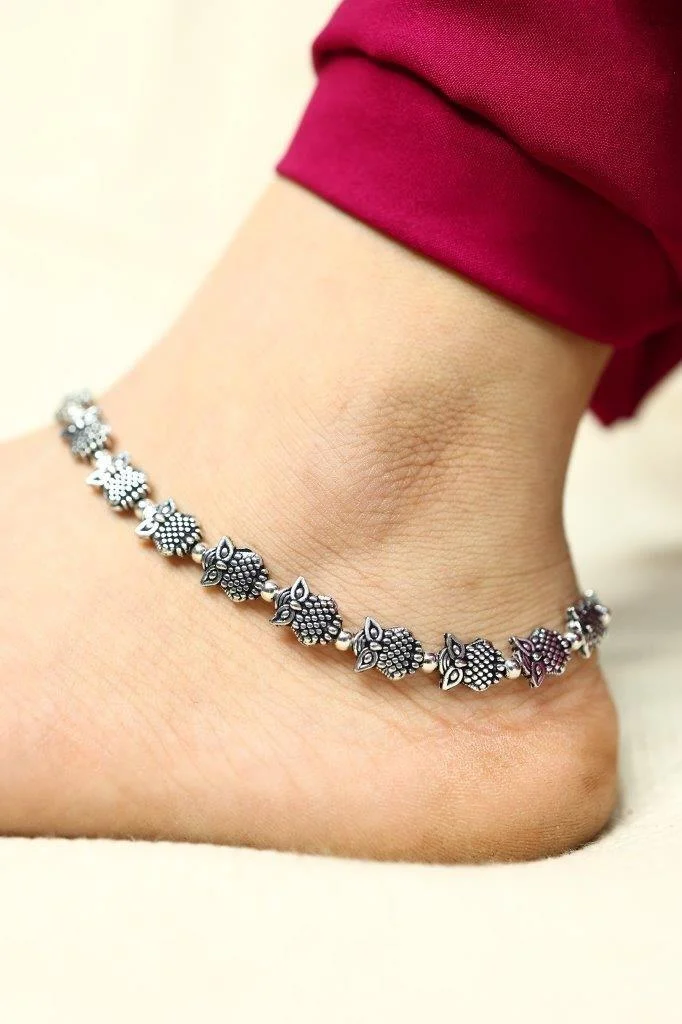
Each bead on this anklet is a bird seen in profile. At the front is a pointed crest with a small round eye below it; behind, the body swells into a dome covered entirely in fine raised granulation — dozens of tiny soldered beads, packed close, standing for folded feathers. They face the same way all along the strand, with a small plain round bead between each pair.
The peacock is the most used motif in Indian ornament and the one that survives most reductions. Rendered at a centimetre it cannot have a tail, so the maker keeps the two things that identify it — the crest and the texture — and lets everything else go. That is why it still reads as a peacock rather than as an abstract bead, and it is the same logic behind the peacocks on a nath or a bugadi.
Granulation is the technique worth paying attention to here. Individual grains of metal are soldered onto a surface without flooding them together, which is slow and old and gives a texture no casting reproduces. Oxidising it afterwards drops shadow between every grain, so the surface reads as deeply textured rather than merely bumpy.
The birds lie along the strand rather than hanging from it, so nothing dangles, nothing swings into a shoe, and the piece is silent.
German silver is the trade name for a bright white alloy of copper, nickel and zinc. It contains no silver at all. What it does have is a hard, cool-toned surface that takes an oxidised finish well and resists scratching better than plated brass, which is why almost every everyday Indian anklet is made to look like it.
At this price it is the most detailed thing in the range. Wear it with bare ankles or cropped trousers where the beads can actually be seen — under a full hem the granulation is wasted.
A note on wearing a pair rather than one. Single anklets have become common and there is nothing wrong with wearing one, but a pair sits differently: the two sounds fall slightly out of step as you walk, which is what produces the soft irregular jingle people associate with payal rather than a single repeating note.
An anklet lives a harder life than any other piece of jewellery. It meets shoes, floors, door frames and bedsheets, and it is the piece most likely to be worn into the shower because taking it off is a nuisance. Water is what dulls an oxidised finish fastest, so slip it off before bathing where you can. A dry soft cloth is the whole cleaning routine — never a silver polish or a dip, which strip the blackening the design depends on.
| Weight (grams) | 0.00 |
| Colour/Finish | Silver |
| Occasion | Festival, Traditional, Daily Wear |
| Gender | women |
| SKU/Product Code | KEYU-NAA3039 |