| Stone Type | Glass & CZ Stones |
| Weight (g) | 0.00 |
| Colour | Red |
| Occasion | Wedding, Festival, Traditional |
Payal is simply the Hindi word for an anklet, and in most of India it is still the first piece of jewellery a girl is given and the last an older woman takes off. It is worn as a pair, one on each ankle, and traditionally it was meant to be heard as much as seen — the sound announced that someone was coming, which in a joint household was a courtesy rather than a performance.
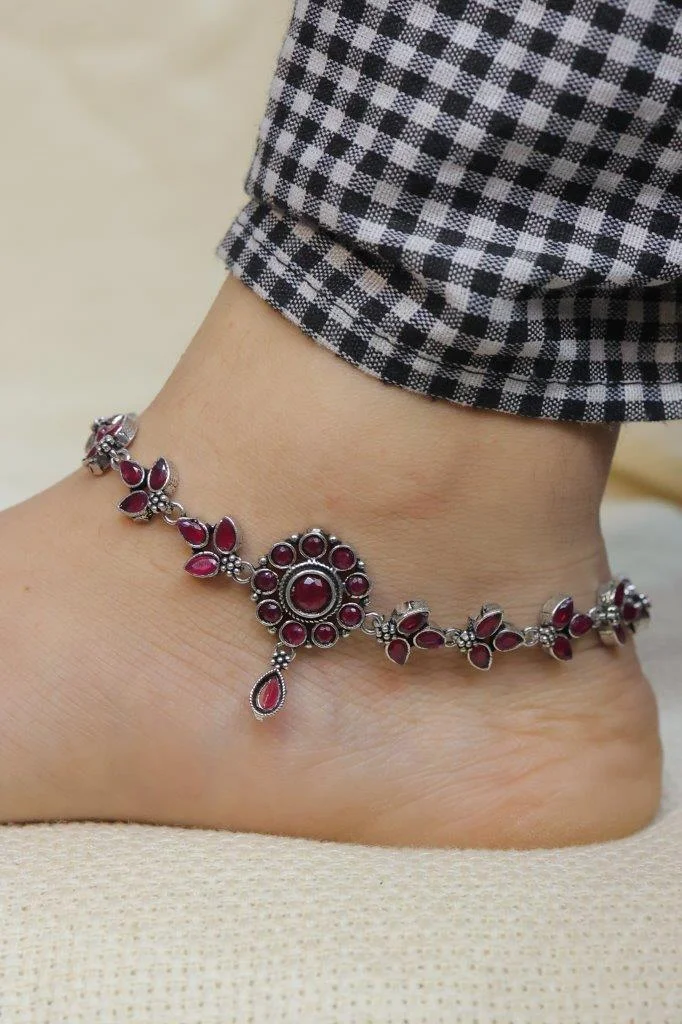
This is the heaviest and most elaborate anklet in the range, and the price reflects the amount of metalwork in it rather than the stones. Between every pair of stones sits a butterfly, worn sideways so the two wings spread along the line of the anklet. The wings are not flat: the upper half is cut as openwork with a punched floral pattern, the lower half is drawn in fine parallel lines like the ribbing of a feather, and the two meet along a central body.
Between every butterfly and the stone beside it sits a cluster of soldered metal beads — three or four grains bunched together. Those clusters are structural as well as decorative: they absorb the movement between links, so a long articulated band like this one flexes smoothly round the ankle instead of hinging at obvious points.
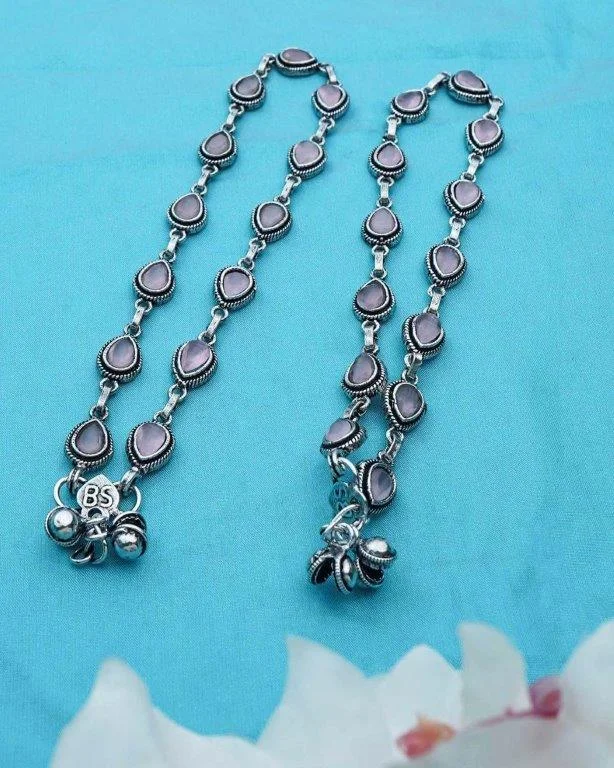
The stones are large pear cuts, set point-down in deep bezels and alternating in two colours along the length. At the ends the anklet closes with a hook and carries a cluster of ghungroo bells.
A word on the stones, because it matters when you are choosing a colour. These are glass and cubic zirconia, not gemstones, cut and polished and set by hand into closed metal bezels. That is the traditional setting for Indian costume jewellery and it does two useful things: the closed back holds the stone securely against the knocks an anklet takes, and it puts a dark oxidised rim around every stone so the colour reads clearly instead of washing out against the metal.
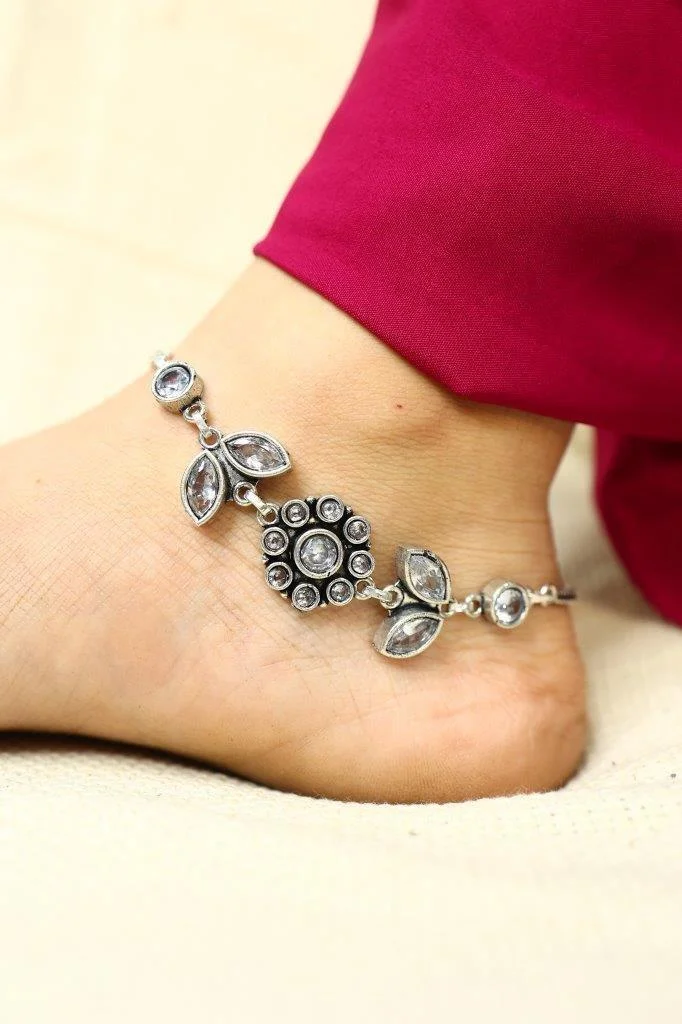
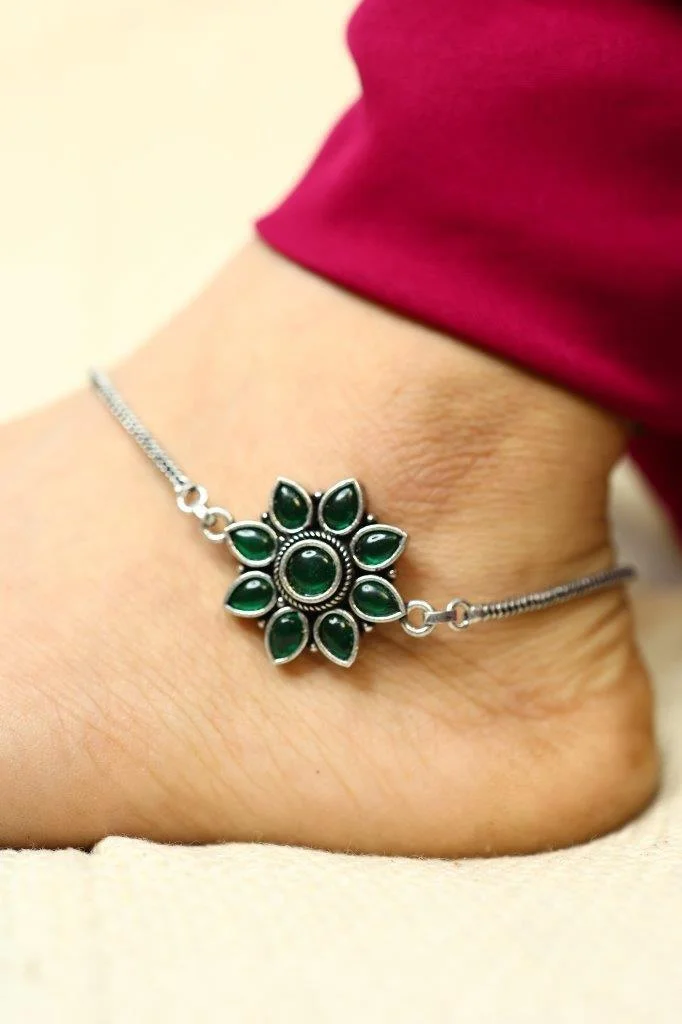
It also means the colours are saturated rather than subtle. A sea green here is a true green-blue, a ruby is a deep pink-red, and the baby pink is pale and milky rather than bright. The photographs on each swatch are of that exact colourway, so trust them over the colour name.
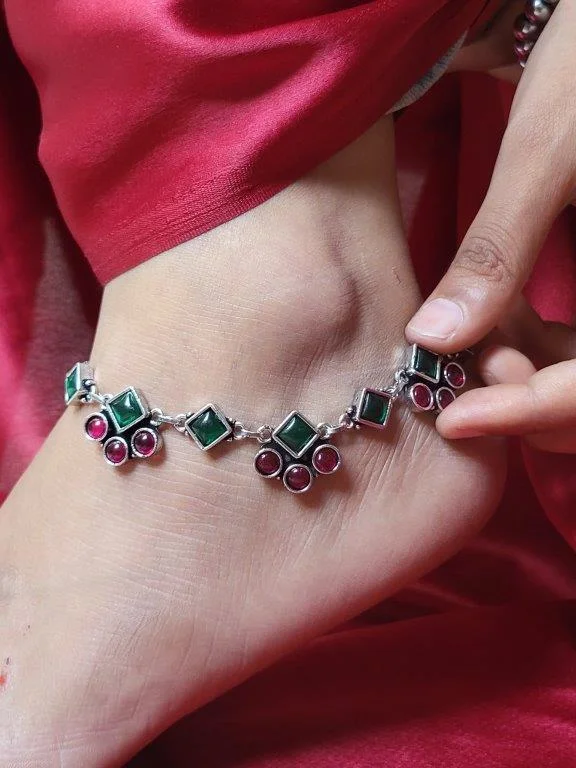
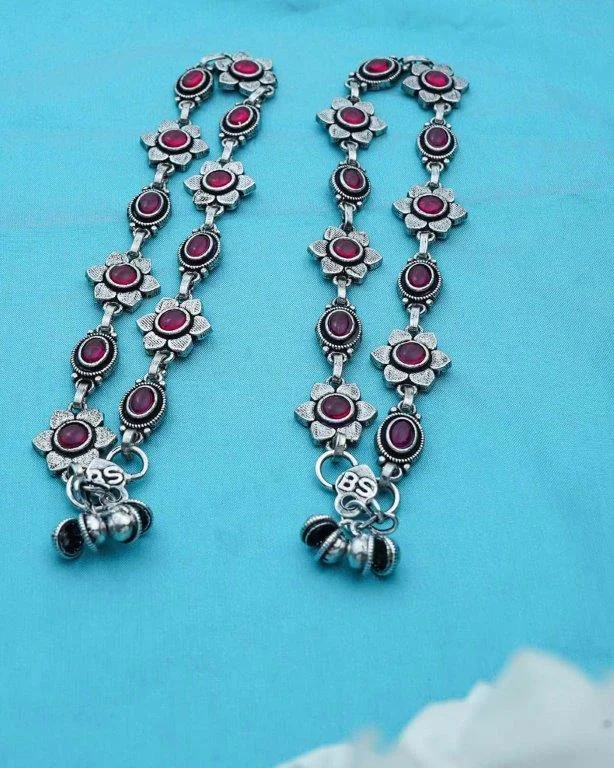
Four colourways are stocked. Red is the two-colour arrangement in the main photograph, alternating deep red and green the way traditional temple jewellery does, and it is the one that looks most like real kundan work from a distance. Sea Green, Baby Pink and Green each run a single colour, which makes the butterflies and the granulation more visible because the eye is not being pulled between two colours.
German silver is the trade name for a bright white alloy of copper, nickel and zinc. It contains no silver at all. What it does have is a hard, cool-toned surface that takes an oxidised finish well and resists scratching better than plated brass, which is why almost every everyday Indian anklet is made to look like it.
This is a wedding and festival anklet. It is substantial enough to be seen under a lehenga hem and detailed enough to reward someone looking at it closely. It is not an everyday piece and it is not one to wear with closed shoes.
A note on wearing a pair rather than one. Single anklets have become common and there is nothing wrong with wearing one, but a pair sits differently: the two sounds fall slightly out of step as you walk, which is what produces the soft irregular jingle people associate with payal rather than a single repeating note.
An anklet lives a harder life than any other piece of jewellery. It meets shoes, floors, door frames and bedsheets, and it is the piece most likely to be worn into the shower because taking it off is a nuisance. Water is what dulls an oxidised finish fastest and it is also what loosens a bezel-set stone over time, so slip it off before bathing. A dry soft cloth is the whole cleaning routine — never a silver polish or a dip, which strip the blackening the design depends on and can fog the stones.
| Stone Type | Glass & CZ Stones |
| Weight (grams) | 0.00 |
| Colour/Finish | Red |
| Occasion | Wedding, Festival, Traditional |
| Gender | women |
| SKU/Product Code | KEYU-NAA1000 |