| Weight (g) | 0.00 |
| Colour | Silver |
| Occasion | Festival, Traditional, Daily Wear |
Payal is simply the Hindi word for an anklet, and in most of India it is still the first piece of jewellery a girl is given and the last an older woman takes off. It is worn as a pair, one on each ankle, and traditionally it was meant to be heard as much as seen — the sound announced that someone was coming, which in a joint household was a courtesy rather than a performance.
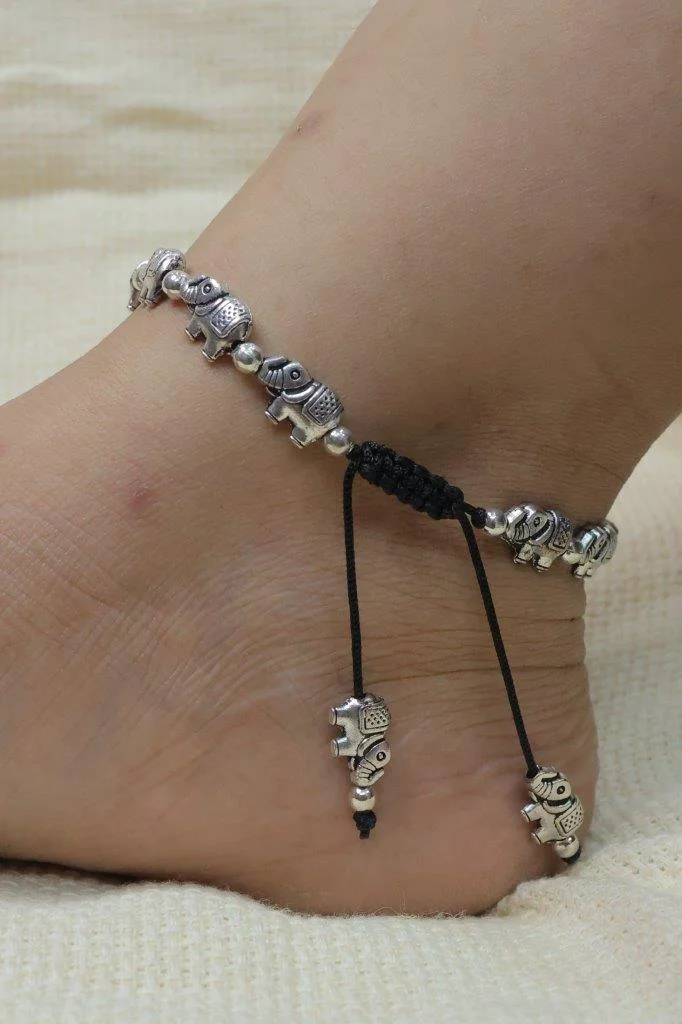
This one combines the two things that make an everyday anklet work: a cord that fits anybody, and metal that is worth looking at. Along the braided black cord sit engraved elephants in profile, trunk curled down, the ear and back cut with fine lines, with small plain beads between them. At the back the cord closes with a sliding knot, and the two loose ends finish in an elephant charm each, so the tails hang down behind the ankle and move as you walk.
The sliding closure is the practical argument for this piece over every chain in the range. A chain is a fixed length and either fits or does not; a sliding knot adjusts over a range of two inches or more, which means it will fit a narrow ankle and a broader one, it will accommodate swelling in hot weather or late pregnancy, and it will still fit in five years. It is also the only closure here that cannot break — there is no clasp and no link to open.
Black cord at the ankle carries the same meaning as a black bead at the throat: a dark thread is held to take an envious look away from the wearer, which is why it is tied on infants and quietly kept up afterwards. Combined with the elephant — the most universally welcome motif in Indian ornament — it makes this one of the few pieces here that is equally right for a newborn's naming ceremony, a wedding and an ordinary day.
German silver is the trade name for a bright white alloy of copper, nickel and zinc. It contains no silver at all. What it does have is a hard, cool-toned surface that takes an oxidised finish well and resists scratching better than plated brass, which is why almost every everyday Indian anklet is made to look like it.
The trade-off is the same as for any cord piece: a textile frays eventually, usually after a year or two of daily wear and faster if it is often wet. Restringing is cheap, and at this price replacement is not a decision.
A note on wearing a pair rather than one. Single anklets have become common and there is nothing wrong with wearing one, but a pair sits differently: the two sounds fall slightly out of step as you walk, which is what produces the soft irregular jingle people associate with payal rather than a single repeating note.
An anklet lives a harder life than any other piece of jewellery. It meets shoes, floors, door frames and bedsheets, and it is the piece most likely to be worn into the shower because taking it off is a nuisance. Water is what dulls an oxidised finish fastest, so slip it off before bathing where you can. A dry soft cloth is the whole cleaning routine — never a silver polish or a dip, which strip the blackening the design depends on.
| Weight (grams) | 0.00 |
| Colour/Finish | Silver |
| Occasion | Festival, Traditional, Daily Wear |
| Gender | women |
| SKU/Product Code | KEYU-NAA3035 |