| Stone Type | Black Glass Bead |
| Weight (g) | 0.00 |
| Colour | Black |
| Occasion | Festival, Traditional, Daily Wear |
Payal is simply the Hindi word for an anklet, and in most of India it is still the first piece of jewellery a girl is given and the last an older woman takes off. It is worn as a pair, one on each ankle, and traditionally it was meant to be heard as much as seen — the sound announced that someone was coming, which in a joint household was a courtesy rather than a performance.
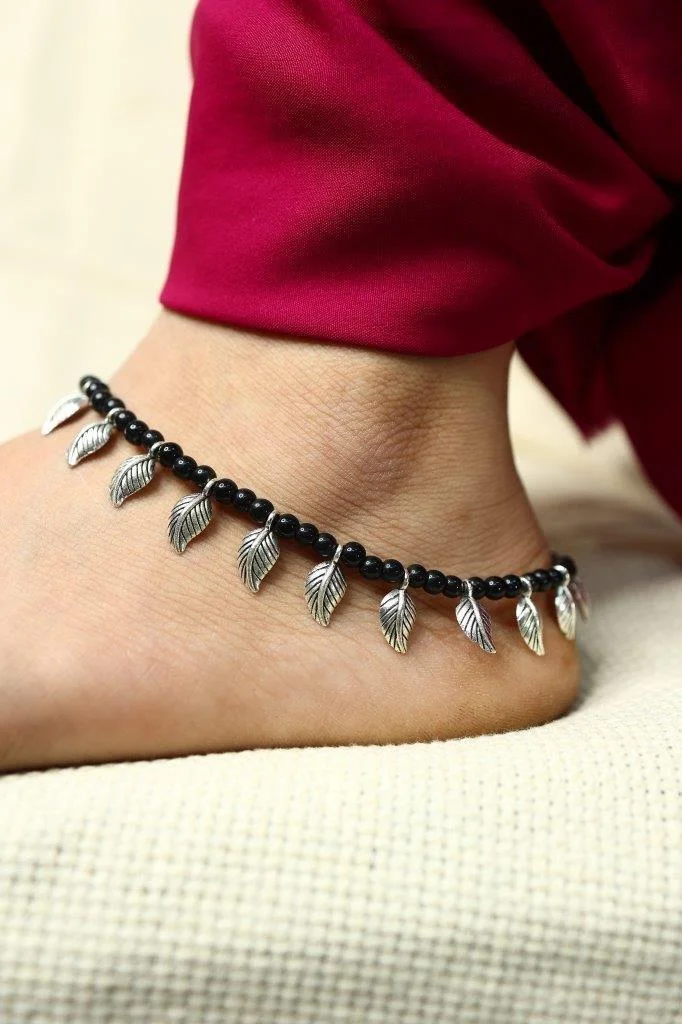
This anklet is strung rather than chained: a continuous row of small round black beads, closely packed, with silver-tone leaf charms hanging between them at regular intervals. Each leaf is flat, veined down its centre and tapered to a point, and they swing freely as you walk.
The combination is doing two things at once. Black beads worn on the body are an old protective habit across India — the dark bead thought to absorb an envious look, which is why they are tied on infants as a nazariya and worn by adults in a mangalsutra. The leaves are purely decorative, and they are what turns a plain protective strand into something you would choose for how it looks.
A strung anklet behaves differently from a chain. It is softer, it follows the ankle more closely, and because the beads are small and many it does not kink or hold a bend. It is also quieter than a chain with bells; the leaves tap against each other rather than ringing.
German silver is the trade name for a bright white alloy of copper, nickel and zinc. It contains no silver at all. What it does have is a hard, cool-toned surface that takes an oxidised finish well and resists scratching better than plated brass, which is why almost every everyday Indian anklet is made to look like it.
This is the one to wear with bare ankles in summer, with cropped trousers, or with a cotton saree. The black reads well against any skin tone and against almost any fabric colour, and at this price it is the anklet you can wear daily without worrying about it.
A note on wearing a pair rather than one. Single anklets have become common and there is nothing wrong with wearing one, but a pair sits differently: the two sounds fall slightly out of step as you walk, which is what produces the soft irregular jingle people associate with payal rather than a single repeating note.
An anklet lives a harder life than any other piece of jewellery. It meets shoes, floors, door frames and bedsheets, and it is the piece most likely to be worn into the shower because taking it off is a nuisance. Water is what dulls an oxidised finish fastest, so slip it off before bathing where you can. A dry soft cloth is the whole cleaning routine — never a silver polish or a dip, which strip the blackening the design depends on.
| Stone Type | Black Glass Bead |
| Weight (grams) | 0.00 |
| Colour/Finish | Black |
| Occasion | Festival, Traditional, Daily Wear |
| Gender | women |
| SKU/Product Code | KEYU-NAA3090 |