| Weight (g) | 0.00 |
| Colour | Silver |
| Occasion | Festival, Traditional, Daily Wear |
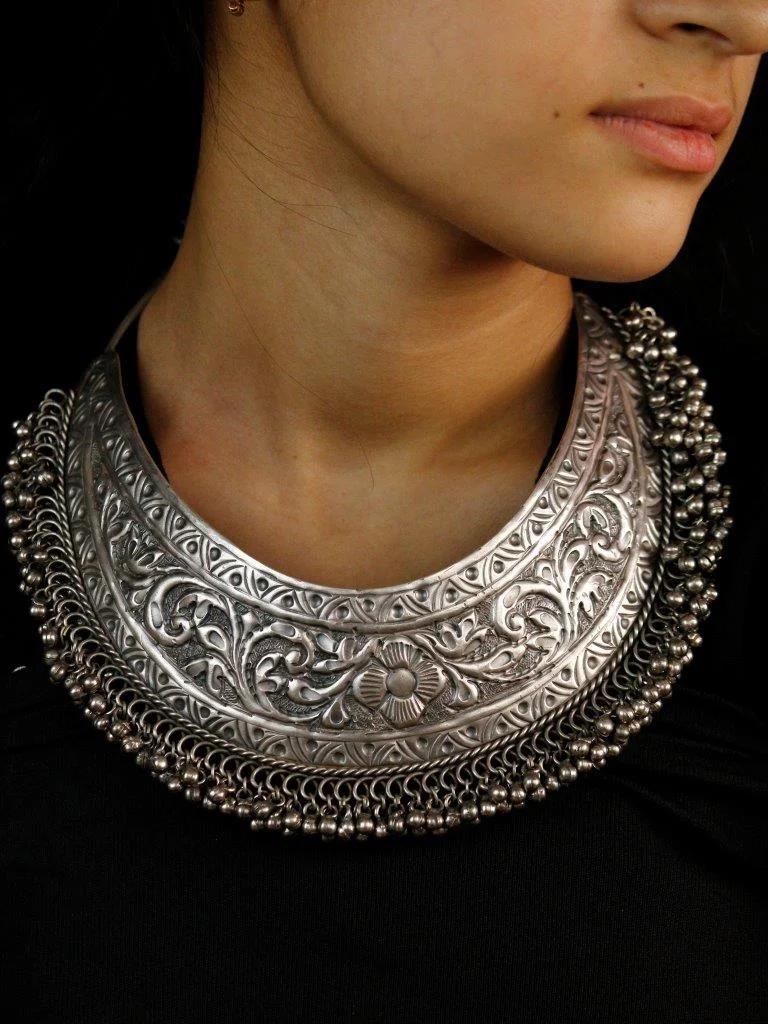
This is the hasli in its most recognisable form: a broad rigid crescent that sits around the base of the throat, following the curve of the collarbone rather than hanging below it. There is no tall standing collar and no wide bib — just the band itself, deep enough to be a real presence and shaped so that it holds its position without needing a clasp at the front.
Across the face of the crescent runs an engraved floral vine, with a rosette at the centre where the band is deepest and the pattern thinning as the band narrows towards each end. The engraving is cut rather than raised, so it reads as fine dark lines against bright metal, and it rewards a close look without demanding one.
The outer edge is where the piece gets its character. All the way round, from one end to the other, hangs a dense fringe of small silver balls, each on its own fine loop, set close enough that they touch. The fringe moves independently of the rigid band, which gives a piece that is otherwise completely solid a soft, shifting lower edge. It is a very old solution to a very old problem: a rigid collar on its own can look severe, and a moving trim fixes that without adding any bulk.
Hasli is named for hansuli, the collarbone, and the rigid crescent is the oldest version of it — worn across Rajasthan, Gujarat and the Deccan, usually in solid silver, as often a store of value as an ornament. This is a replica in brass finished to read as old silver, which is what makes the scale affordable and the weight easy.
It opens at the back and adjusts. Because it stays high and close rather than falling onto the chest, it is the most wearable of the large silver pieces here: it works over a plain kurta, with a high-necked blouse, or against a bare neckline, and it does not interfere with a dupatta the way a wide bib does. Wear it alone, keep earrings small, and let the ball fringe be the only moving thing. It is particularly good against black, rust and undyed cotton.
If you are choosing between the pieces in this range, the difference is really about how much of you the necklace covers. The bib collars spread across the chest and need a plain, uncluttered outfit built around them. This one stops at the collarbone, so it adds weight at the throat without taking over, and it can be worn on an ordinary day as well as a formal one. It is the version to buy if you want a tribal silver collar you will actually reach for more than twice a year.
One thing to expect: a rigid crescent does not drape, so it will sit where its own shape puts it rather than following your neck exactly. Adjust the opening at the back until the two ends sit evenly behind the shoulders, and the front will centre itself. Pieces like this were made by hand and small asymmetries between one end and the other are normal rather than faults.
Base metal is brass with a silver-tone finish. Supplier stock is limited, so this is listed for WhatsApp enquiry rather than direct checkout.
This is brass with a bright silver-tone plating rather than solid or sterling silver, which is what keeps the price where it is. Plating is a surface rather than a bulk property, so how long it lasts depends almost entirely on what it meets — perfume, hairspray and sweat all shorten it, while a dry cloth after wearing and a closed pouch between wearings extend it considerably.
Put this on after perfume, hairspray and hand cream, and take it off before washing, swimming or sleeping. Wipe with a dry soft cloth and use a dry soft brush around the stone settings and between any pearls, where a cloth cannot reach. Store it in a zip-lock pouch — which is what the supplier themselves advise, and the single most effective thing for a plated piece, because it keeps humid air off the metal. Never use silver polish, dip cleaners or an ultrasonic cleaner.
| Weight (grams) | 0.00 |
| Colour/Finish | Silver |
| Occasion | Festival, Traditional, Daily Wear |
| Gender | women |
| SKU/Product Code | KEYU-NAA2175 |