| Weight (g) | 0.00 |
| Colour | Silver |
| Occasion | Festival, Party, Traditional |
This is a band choker rather than a strung one: a single curved strip of metal, about three-quarters of an inch deep, that sits flat against the base of the throat and holds its own shape. Across its face runs a repeating lotus and vine pattern, engraved and then oxidised so the blackening stays down in the cut lines while the surface between them comes up bright. Along the top edge runs a twisted rope border, the oldest and simplest way of finishing a silver band, and it does what it has always done — it stops the upper edge looking cut and gives the eye something to follow.
The lower edge is the part that moves. A dense row of small silver ghungroo bells hangs from linked rings all the way along, close enough that they touch, so they shift and chime very faintly as you walk. On a piece that is otherwise completely rigid, that moving fringe is what keeps it from reading as severe.
Behind the band, a black adjustable thread ties at the nape. It slides, so the choker can be set close at the throat or let out a little, and it will fit over a high-necked blouse as easily as bare skin. A choker is the one necklace where fit genuinely matters — too loose and it slides down onto the collarbone and loses the whole point of it — and an adjustable tie handles that far better than a fixed clasp.
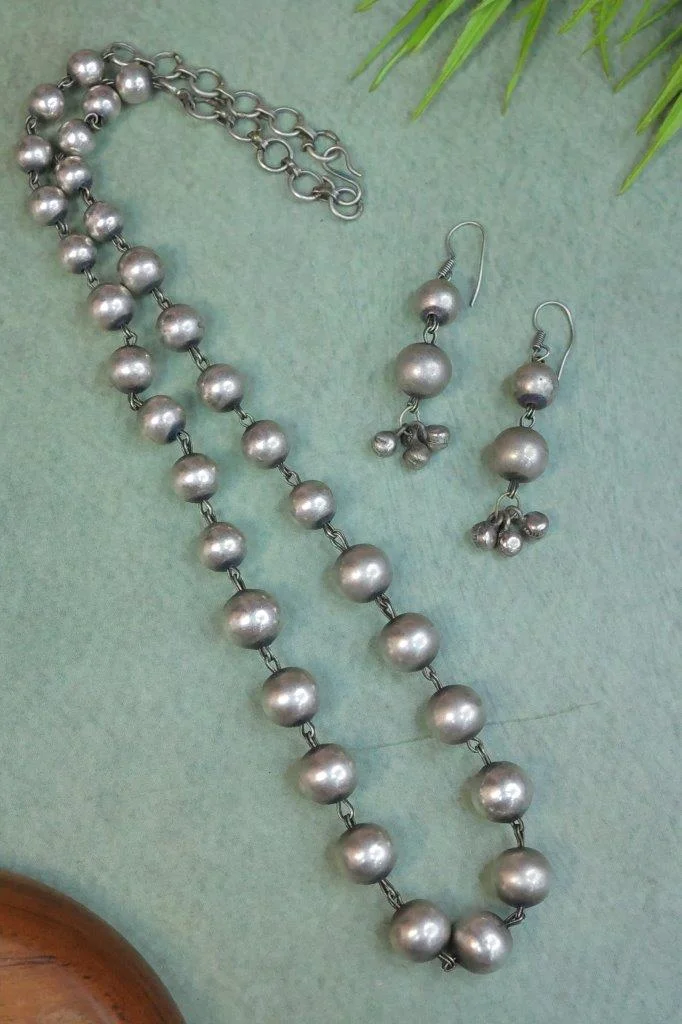
There are no stones. This is an entirely metalworking piece in the Banjara and Rajasthani idiom, where a woman's silver was weight and value as much as decoration, and where the ghungroo fringe served a social purpose as well as a decorative one.
It is a silver replica: brass worked and oxidised to read as old silver, which is what makes a band this wide affordable and light enough to wear through an evening. Solid silver at this scale would be noticeably heavy at the throat.
Wear it against bare skin or a plain dark neckline, with the hair up so the full depth of the band shows. It is strongest with black, indigo, rust and undyed cotton, and it belongs with a plain outfit rather than an embroidered one. Keep earrings small; a jhumka and a bell fringe together is one moving thing too many.
Base metal is brass with an oxidised silver-tone finish. Store it flat and pouched — a bell fringe tangles with chains and the loops bend if pulled apart in a hurry.
One thing to expect from a rigid band, because it is different from every other necklace. It does not drape. A strung necklace follows your neck exactly; a band holds the curve it was made with, so it will sit slightly away from the throat at the sides on a narrow neck and press a little closer on a broader one. Adjusting the thread changes how high it sits but not that curve. In practice it settles within a few minutes of wearing and stops being noticeable, but it is worth knowing before the first wear rather than discovering it in front of a mirror.
This is brass given an oxidised, antique-silver finish rather than solid silver. The metal is darkened and the raised surfaces are then polished back, so the blackening stays in the recesses while the high points stay bright. That contrast is the whole point of oxidised work — it is what makes every engraved line and pierced opening read separately instead of dissolving into one shiny surface, and it means small variations between pieces are normal rather than faults.
Put this on after perfume, hairspray and hand cream, and take it off before washing, swimming or sleeping. Wipe with a dry soft cloth and use a dry soft brush around the stone settings and between any pearls, where a cloth cannot reach. Store it in a zip-lock pouch — which is what the supplier themselves advise, and the single most effective thing for a plated piece, because it keeps humid air off the metal. Never use silver polish, dip cleaners or an ultrasonic cleaner.
| Weight (grams) | 0.00 |
| Colour/Finish | Silver |
| Occasion | Festival, Party, Traditional |
| Gender | women |
| SKU/Product Code | KEYU-NAA2173 |