| Weight (g) | 0.00 |
| Colour | Silver |
| Occasion | Traditional, Daily Wear, Casual |
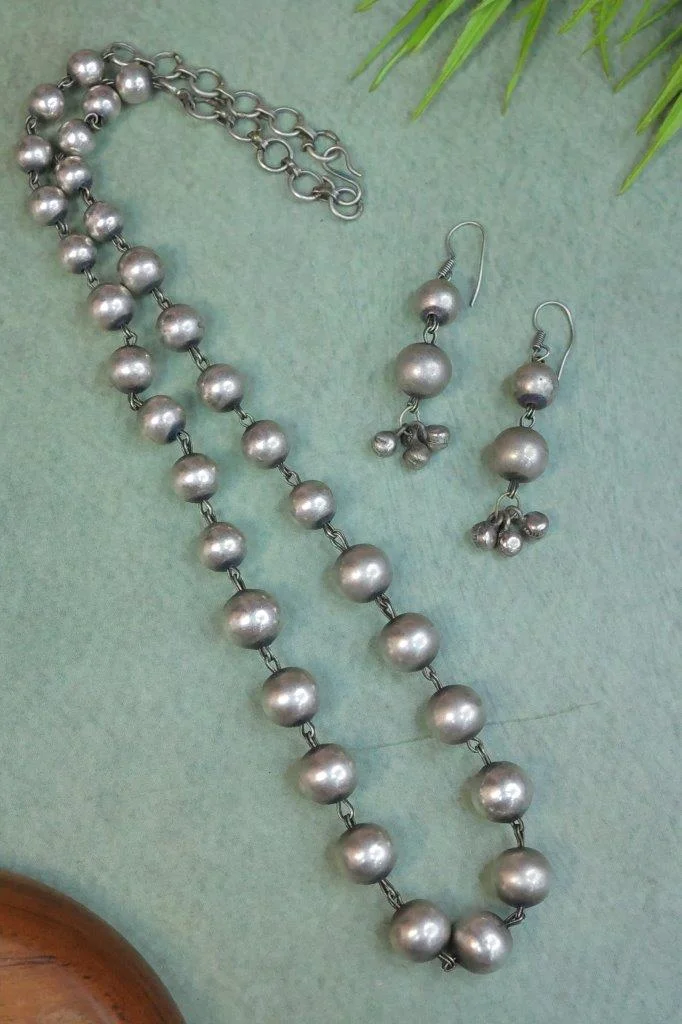
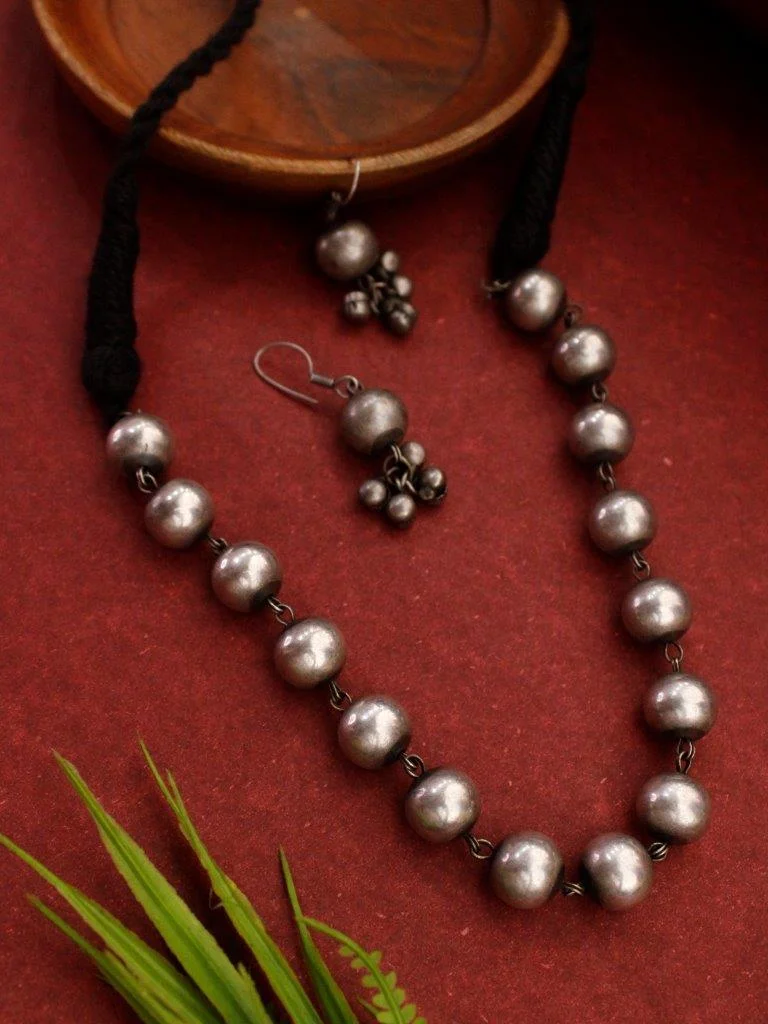
This is the plainest necklace in the choker range and the one most likely to be worn. A single row of large round silver-tone balls, each linked to the next, sits close at the base of the throat on a black cotton cord that ties at the nape. The balls are smooth and slightly domed rather than perfectly spherical, and they are oxidised — darkened and polished back, so they hold a dull pewter sheen rather than a mirror shine.
That finish is the whole reason a piece this simple works. A row of bright polished balls would look like costume jewellery; the same row oxidised looks like tribal silver, because that is exactly what it is copying. Ball necklaces of this kind run through Banjara, Rajasthani and Kutchi work, where the metal itself was the point and decoration was secondary to weight.
The matching earrings are small hooks ending in a cluster of tiny ghungroo bells — a different shape from the necklace rather than a miniature of it, which is the right choice here. Repeating a plain ball at the ear would have been dull; a cluster adds movement and a faint sound without adding a second idea.
The cord ties and slides, so it adjusts from tight at the throat to sitting an inch lower. A choker needs that: too loose and it falls onto the collarbone and stops being a choker at all.
What makes this the useful piece in the range is how little it asks. There are no stones to fall out, nothing to tangle, nothing festive about it, and it is light. It goes with a cotton kurta, a plain black top, a linen shirt and jeans just as readily as with a saree, and it layers under a longer chain without either piece fighting the other. If you want one oxidised necklace that you will actually reach for on an ordinary Tuesday, this is it.
Base metal is brass with an oxidised silver-tone finish. Keep it away from silver polish and dip cleaners — both strip the oxidation, which is the finish you are buying. A dry soft cloth is all it needs.
The cord is worth a sentence, since it is the part that will eventually need attention. It is cotton, and cotton frays where it passes through the end loops, usually after a year or two of regular wear. Restringing is a five-minute job for any jeweller and costs almost nothing, so a worn cord is a reason to replace the cord rather than the necklace. If you would rather pre-empt it, keeping the piece dry and not tugging the cord to put it on will add considerably to its life.
This is brass given an oxidised, antique-silver finish rather than solid silver. The metal is darkened and the raised surfaces are then polished back, so the blackening stays in the recesses while the high points stay bright. That contrast is the whole point of oxidised work — it is what makes every engraved line and pierced opening read separately instead of dissolving into one shiny surface, and it means small variations between pieces are normal rather than faults.
Put this on after perfume, hairspray and hand cream, and take it off before washing, swimming or sleeping. Wipe with a dry soft cloth and use a dry soft brush around the stone settings and between any pearls, where a cloth cannot reach. Store it in a zip-lock pouch — which is what the supplier themselves advise, and the single most effective thing for a plated piece, because it keeps humid air off the metal. Never use silver polish, dip cleaners or an ultrasonic cleaner.
| Weight (grams) | 0.00 |
| Colour/Finish | Silver |
| Occasion | Traditional, Daily Wear, Casual |
| Gender | women |
| SKU/Product Code | KEYU-NAA2109 |