| Stone Type | Monalisa Stone, Kundan |
| Weight (g) | 130.00 |
| Colour | White |
| Occasion | Wedding |
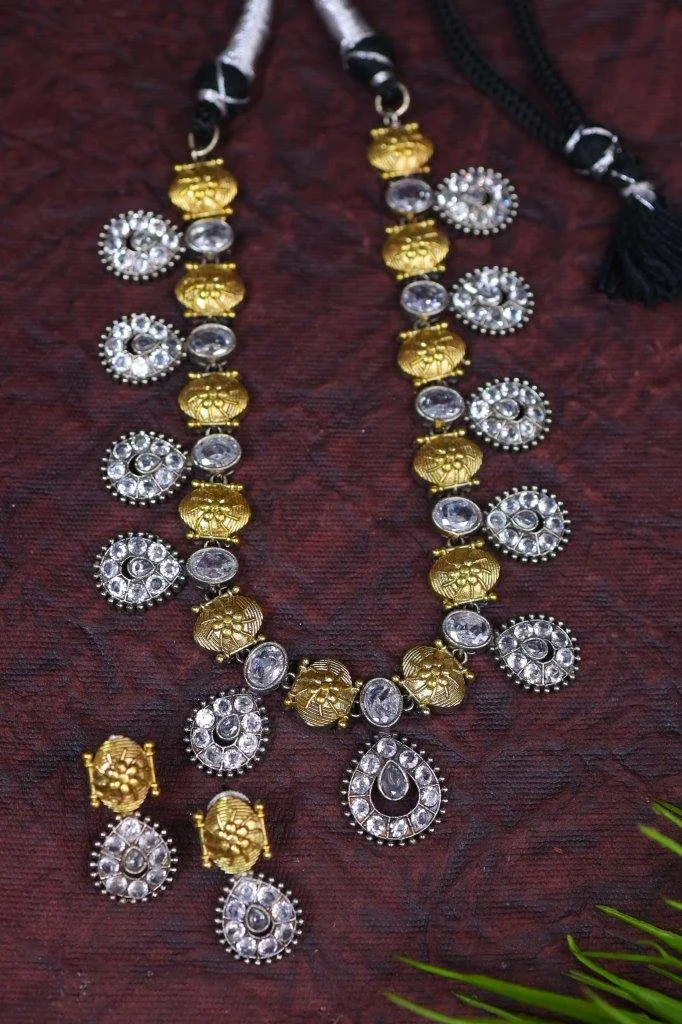
Two strands hang from a black dori, each built from alternating units: a ribbed gold oval, then a silver disc with a beaded rim set with stones in several colours around a central cabochon. The strands meet at a teardrop pendant set the same way, with a turquoise and a red stone above it. The matching studs pair a ribbed gold top with a small stone set teardrop.
Available in 3 colours: White, Green and Ruby. The colour refers to the dominant stone in each disc.
Two strands of the same unit, offset so the discs of one row sit between the discs of the other, give the piece depth that a single row cannot. It fills the space between throat and chest rather than drawing one line across it.
The multicoloured setting is the real character here. Each disc carries several stone colours at once, so the necklace reads as richly coloured from a distance and as intricate up close, which is a difficult combination to achieve with one stone per setting.
Beaded silver rims around a cluster of stones, with a larger cabochon at the centre of each. The beading catches light between the stones and stops the discs from reading as flat buttons.
Plain ribbed gold, no stones. They separate the discs and give the eye a rest between each cluster of colour — without them the strands would be relentless.
The upper strand sits near the collarbone and the lower one below it, with the pendant at the centre. This is a substantial piece, suited to a ceremony, and it ties with a dori so the fit adjusts.
Solid coloured silks and lehengas with an open neckline. Because the stones are multicoloured, almost any outfit colour picks up something in the piece, though plain fabrics suit it better than prints. Keep earrings small — the matching studs are deliberately restrained.
Navratna means nine gems, and the traditional arrangement sets ruby at the centre with diamond, pearl, coral, emerald, yellow sapphire, blue sapphire, hessonite and cat's eye placed around it, each associated with one of the nine celestial bodies of Indian astrology. The combination was believed to balance their influences, which is why navratna ornaments were worn as much for protection as for display, and why the full set had to be present for the piece to work. Modern navratna style jewellery keeps the look — many colours clustered in a single setting — without claiming the stones themselves, and that multicoloured cluster remains one of the most recognisable patterns in Indian ornament.
Store it flat in a pouch so the two strands do not tangle. Keep the dori dry, put it on after perfume, and wipe with a dry soft cloth.
| Stone Type | Monalisa Stone, Kundan |
| Weight (grams) | 130.00 |
| Colour/Finish | White |
| Occasion | Wedding |
| Gender | women |
| SKU/Product Code | KEYU-NAA3254 |