| Stone Type | Kundan, Pearl |
| Weight (g) | 140.00 |
| Colour | Blue |
| Occasion | Wedding |
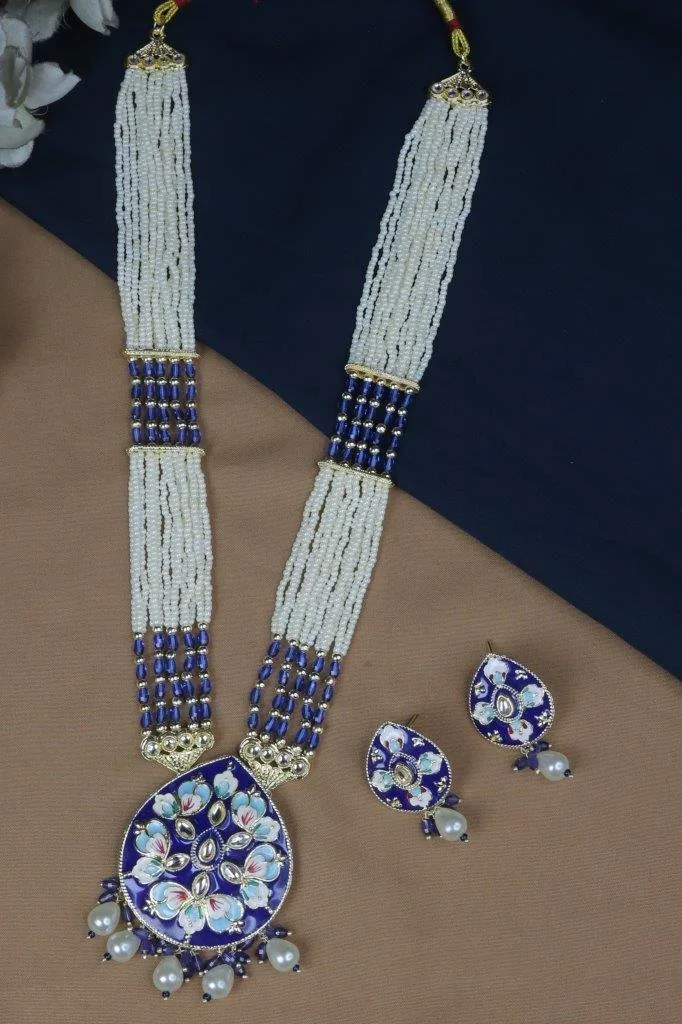
Five strands of small white seed pearls run from gold caps at the shoulders, broken twice along their length by bands of coloured barrel beads and gold spacer bars. They gather into a large teardrop pendant finished in hand painted enamel, its coloured ground covered with pale flowers and leaves and set with kundan at the centre of each bloom. Pearl and bead drops hang along the lower edge, and the earrings are smaller teardrops painted to match.
Available in 6 colours: Pink, Blue, Teal Green, Purple, Red and Green. The colour refers to the enamel ground and the coloured beads.
The painting is the whole piece. Each flower is applied by hand, in several colours, with shading inside the petals, so the pendant carries more detail than any amount of stone setting could give it at the same weight.
Against that density, the strands are deliberately plain — small white pearls, repeated hundreds of times. It is a straightforward contrast and an effective one: the busiest thing sits where the eye naturally goes, and everything above it stays quiet.
Five rows, interrupted twice by bands of coloured beads with gold spacers. Those breaks stop such a long run of pearls from reading as a single pale mass and give the necklace a sense of sections.
Enamel is fused onto the metal and then painted, so the colour sits in the surface rather than on it and will not rub away the way a printed finish would. The pale flowers over a deep ground is the classic Jaipur arrangement.
Long, with the pendant falling at the centre of the chest. It is a bridal weight piece, and the many strands distribute that weight across the shoulders rather than concentrating it at the back of the neck.
Lehengas, heavy silks and anarkalis. Pick the enamel colour to match or deliberately contrast the outfit — because the flowers are pale, both approaches work.
Meenakari is the art of fusing coloured enamel onto metal, brought to Rajasthan by artisans from Lahore under the patronage of Raja Man Singh in the sixteenth century, and centred on Jaipur ever since. The metal is engraved first, the enamel is laid into the hollows as a powder, and the piece is fired so the powder melts and fuses; each colour is fired separately, starting with the one that needs the highest heat. Traditionally the enamel was applied to the reverse of a kundan piece, so the wearer had a second, hidden design — which is why the finest old pieces are as beautiful from behind as from the front.
Store it flat in a pouch so the strands do not tangle. Keep the enamel away from water and perfume, and wipe only with a dry soft cloth.
| Stone Type | Kundan, Pearl |
| Weight (grams) | 140.00 |
| Colour/Finish | Blue |
| Occasion | Wedding |
| Gender | women |
| SKU/Product Code | KEYU-NAA3281 |