| Stone Type | Mirror |
| Weight (g) | 120.00 |
| Colour | Multi Color |
| Occasion | Festival |
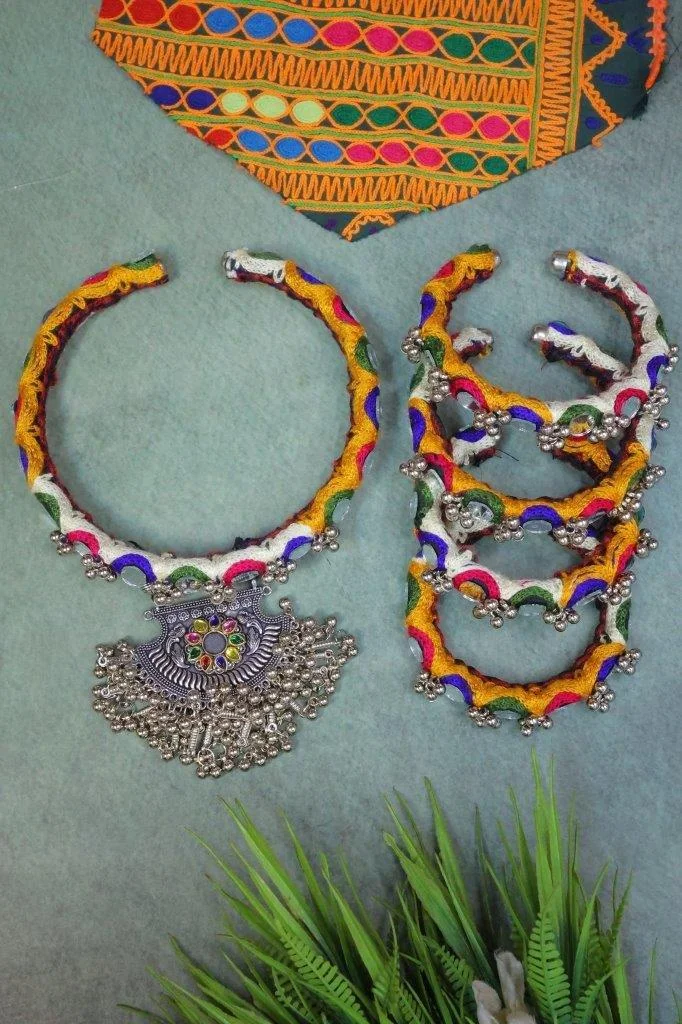
A rigid collar wrapped entirely by hand in coloured thread — yellow, red, green, blue and white worked in bands and zigzags — with small round mirrors set into the wrapping and a row of tiny silver ghungroo bells along the lower edge. At the front hangs a broad silver fan pendant, its surface set with coloured stones around a mirror centre and its lower edge filled with a dense fringe of bells and dangles. Matching thread wrapped bangles come with it.
Available in Multi Color — the full range of thread colours shown.
Every inch of the thread is wound by hand, and the pattern shifts as it goes — the bands are not identical and the mirrors are not evenly spaced. That irregularity is the mark of genuine Kutchi work and the reason no two pieces are alike.
The silver pendant against the bright thread is a deliberate collision of materials. Neither half would carry the piece alone; together they make one of the most recognisable looks in Indian folk jewellery.
Small round mirrors set into the thread, the same abhla work used in Kutchi embroidery. They catch light as you move and are the reason the necklace reads as bright even in a dim room.
Dozens of small silver bells along the collar and packed under the pendant. They make a soft sound as you move — an intended part of the piece, not an accident of construction.
Wrapped in the same threads and finished with the same bell fringe, so the set reads as one piece of work rather than a necklace with accessories.
As a rigid collar at the base of the throat. It holds its own shape and sits away from the skin rather than draping.
Plain solid cotton and handloom — black, white, indigo, rust — where the thread colours can do all the work. It is completely wrong with a printed or embroidered outfit and completely right with a plain one.
The thread and mirror work of Kutch, in western Gujarat, developed in communities where metal was expensive and textile skill was universal. Mirrors were originally mica, then blown glass cut into discs, sewn into embroidery to catch light and, in folk belief, to turn away the evil eye by reflecting it back. The jewellery follows the same logic as the embroidery: bright contrasting colour, dense pattern, small mirrors, and silver used sparingly where it matters most. Because every piece is wound by hand over a base, the making is slow, and the small inconsistencies between one and the next are the clearest sign that a piece is genuinely handmade rather than machine assembled.
Keep the thread completely dry — it cannot be washed. Store it in a pouch away from anything that could catch the bells, and never spray perfume onto it.
| Stone Type | Mirror |
| Weight (grams) | 120.00 |
| Colour/Finish | Multi Color |
| Occasion | Festival |
| Gender | women |
| SKU/Product Code | KEYU-NAA3052 |