| Stone Type | Monalisa Stone, Pearl |
| Weight (g) | 95.00 |
| Colour | Green |
| Occasion | Festival |
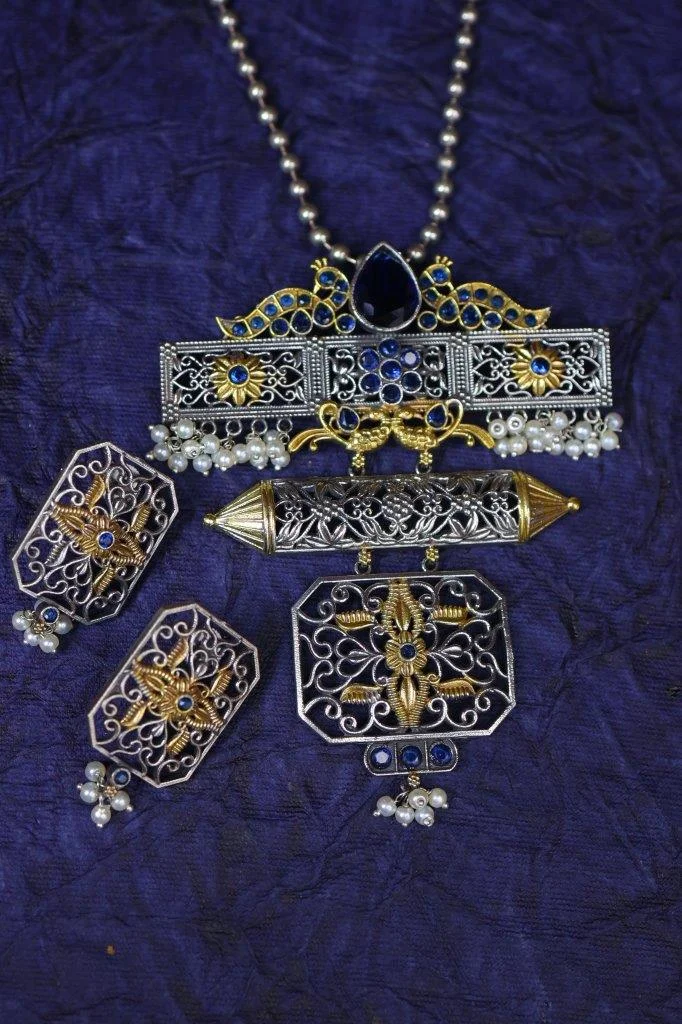
Three panels hang in sequence from a long silver ball chain. At the top, a rectangular bar of pierced silver with gold rosettes, crested by two gold peacocks and a teardrop stone, with pearl clusters beneath. Below it, a slim openwork tube capped with gold cones. Below that, a large octagonal plaque of dense filigree with a gold floral cross at its centre and small pearl drops at its base. The earrings are octagonal plaques in the same filigree, each with a gold flower and a pearl cluster.
Available in 3 colours: Multi Color, Green and White. The colour refers to the stones set through the panels.
Stacking three separate panels instead of making one large pendant is what gives this its length and its rhythm. Each panel is a different shape and a different density, so the eye reads them as a sequence rather than as a single mass, and the gaps between them are as much a part of the design as the metal.
All three are pierced rather than solid, which means skin or fabric shows through the openwork. That is the reason a pendant this large stays light both visually and physically.
Fine silver scrollwork fills each panel edge to edge, with gold applied on top as flowers and rosettes. The contrast works because the silver is busy and the gold is simple — reversing it would have made the panels unreadable.
Two gold peacocks sit along the top edge of the first panel with a teardrop stone between them, so the necklace begins with its most ornamental moment and calms down as it descends.
Long. The top panel sits near the collarbone and the lowest plaque well below it. Light for its size because of the openwork, and comfortable for a full evening.
Plain solid fabrics in black, indigo, white, rust or mustard, where the pierced panels read clearly. Avoid busy prints, which fight the openwork.
Filigree is built from drawn wire rather than cut from sheet. Fine threads of silver are twisted, coiled and then soldered to each other and to a frame, so the pattern is genuinely made of gaps — there is no backing behind it. The technique is ancient and survives in India chiefly in Odisha, where Cuttack's tarakasi work is the best known example and the wire used can be finer than a hair. Because every join is soldered by hand, a filigree panel takes far longer to make than a stamped one of the same size, and it is easy to tell them apart: stamped work has uniform rounded edges where the die pressed the metal, while true filigree shows individual wires meeting at visible joins.
Store it flat in a pouch and lift it by the chain, not by the panels. Put it on after perfume and wipe with a dry soft cloth.
| Stone Type | Monalisa Stone, Pearl |
| Weight (grams) | 95.00 |
| Colour/Finish | Green |
| Occasion | Festival |
| Gender | women |
| SKU/Product Code | KEYU-NAA3255 |