| Stone Type | Mirror |
| Weight (g) | 130.00 |
| Colour | Multi Color |
| Occasion | Festival |
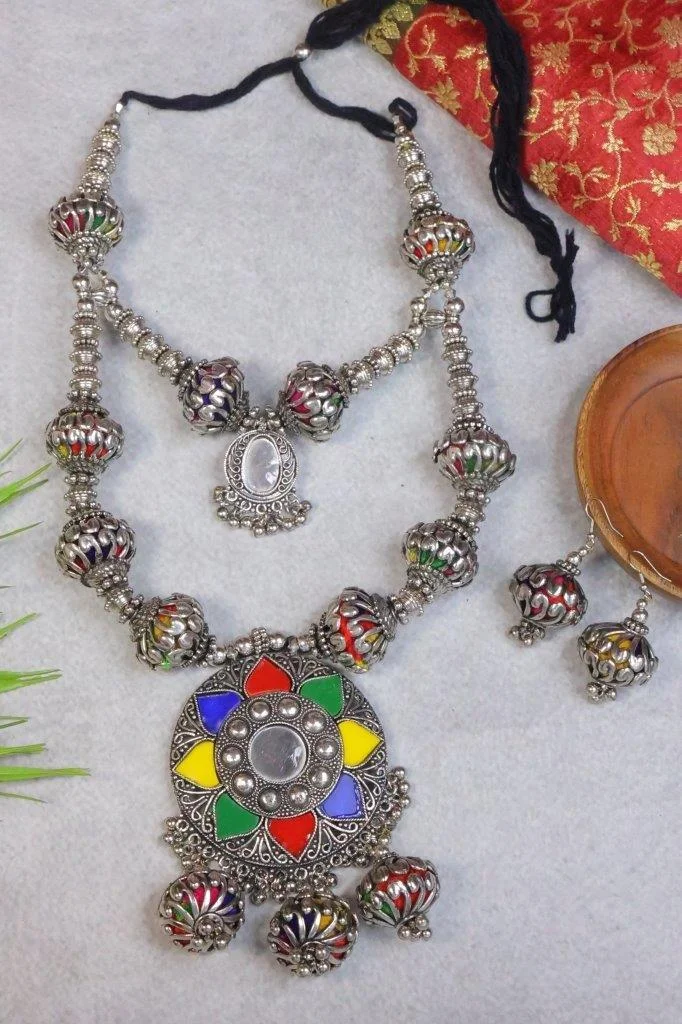
Two rows of large hollow silver beads, each pierced in a filigree pattern and inlaid with red, green, blue and yellow enamel between the metal, separated by small ridged spacer beads. The rows meet at a round medallion — a mirror at its centre ringed with silver granules, surrounded by enamel petals in alternating colours, with three enamel bead drops hanging below. A smaller matching pendant hangs from the upper row, the whole piece ties with black thread, and the earrings are single enamel beads.
Available in Multi Color — red, green, blue and yellow enamel throughout.
Colour here is held inside metal rather than set on top of it. Each bead is pierced first and the enamel fills the gaps, so the silver lattice shows through the colour and the two are genuinely one surface.
The scale is unapologetic. These are large beads, worn in two rows, and the piece makes no attempt to be delicate — which is exactly the character of the Afghan and Central Asian silver it descends from.
A mirror at the centre, ringed by silver granules and then by enamel petals, so the eye moves outward in three distinct bands from a single reflective point.
An upper row sitting close at the throat and a lower one falling below it, with a small pendant on the upper row so it does not read as merely a support for the lower.
Substantial, as this style always is. It ties with black thread so the length adjusts, and the hollow beads keep the weight lower than their size suggests.
Plain solid cotton and handloom in black, white, indigo or rust. This is the entire outfit's jewellery — earrings are supplied and nothing else is needed.
Large hollow silver beads with coloured enamel inlay belong to a tradition running from Afghanistan and Central Asia through Rajasthan and Kutch, carried along trade and migration routes over centuries. The beads are hollow for a practical reason — solid silver at that size would be unwearable and unaffordable — and the piercing that makes them light is also what creates the pattern for the enamel to fill. Mirrors and bells were added where the style met Indian folk jewellery. The look has stayed popular because it is instantly recognisable, it suits plain modern clothing as well as traditional dress, and unlike stone set jewellery there is nothing in it that can fall out.
Never use a silver dip, which strips the oxidised finish. Wipe with a dry soft cloth, keep the thread dry, and store it flat in a pouch.
| Stone Type | Mirror |
| Weight (grams) | 130.00 |
| Colour/Finish | Multi Color |
| Occasion | Festival |
| Gender | women |
| SKU/Product Code | KEYU-NAA3036 |