| Stone Type | Monalisa Stone, Pearl |
| Weight (g) | 80.00 |
| Colour | Blue |
| Occasion | Festival |
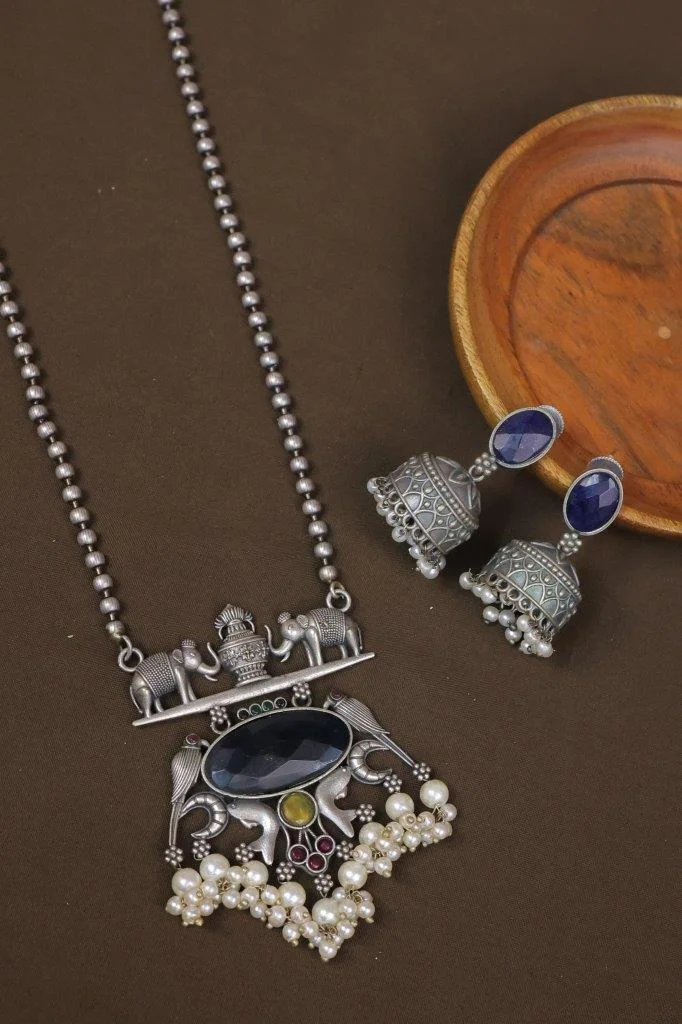
A long silver ball chain carries a pendant in two tiers. Above, a horizontal bar with two elephants facing a fluted temple kalash between them. Below, a large faceted oval stone in a plain bezel, flanked by peacocks with raised tails and finished with a small stone flower and dense pearl clusters along the lower edge. The matching earrings are pierced jhumkas beneath oval stone studs.
Available in 7 colours: Blue, Ruby, White, Baby Pink, Red, Yellow and Green. The colour refers to the large oval stone.
Two animals on one pendant is unusual — most designs pick either elephants or peacocks. Separating them onto two tiers is what makes it work: the elephants are static and architectural on the bar above, the peacocks are curved and moving around the stone below.
Between them sits the kalash, the ceremonial pot, which is the element that explains the composition. Elephants flanking a kalash is a temple doorway arrangement, and the pendant is effectively a small gateway with the stone hanging beneath it.
Large and faceted, in a plain bezel with no decoration at all, so it stays the clear centre of a pendant that has a great deal going on around it.
Packed along the lower edge in several sizes, softening the outline and giving the pendant somewhere to end.
Long, with the pendant at mid chest on a ball chain. Substantial in appearance and moderate in weight.
Plain cotton, handloom and simple silk. Because it hangs low it works with high necklines and closed collars.
Traditional Indian pendants are rarely arbitrary collections of motifs — most reproduce an arrangement from temple architecture or sculpture at a small scale. The kalash flanked by animals, the deity framed by attendants, the arch over a figure: each has a fixed grammar, and pieces that follow it look resolved while pieces that borrow motifs at random look assembled. It is worth looking at where the elements sit relative to each other rather than just what they are, because the arrangement is usually what separates a well designed piece from a busy one.
A pendant at mid chest needs to hang clear of the fabric it sits on, which means it works best over a plain area rather than across a border, a print or a pleat. With a saree that usually means keeping it in front of the pallu rather than under it; with a kurta it means checking that the pendant is not resting on a placket or a button line. The pearls at the base are the part most likely to catch, so it is worth lifting the pendant clear before sitting down or adjusting a dupatta.
Never use a silver dip, which strips the oxidised finish. Wipe with a dry soft cloth and store flat so the pearl clusters are not crushed.
| Stone Type | Monalisa Stone, Pearl |
| Weight (grams) | 80.00 |
| Colour/Finish | Blue |
| Occasion | Festival |
| Gender | women |
| SKU/Product Code | KEYU-NAA2824 |