| Stone Type | Kundan, Pearl |
| Weight (g) | 95.00 |
| Colour | Red |
| Occasion | Wedding |
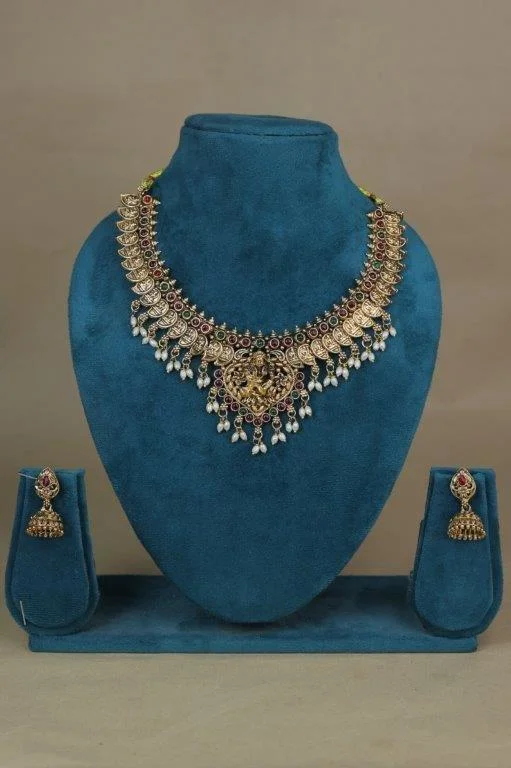
A close fitting necklace built from a dense row of mango shaped motifs, each set with a red or green stone and outlined in fine granulated gold. The row deepens toward the front, where a Lakshmi medallion sits at the centre framed by larger stones, and small pearl drops hang from almost every motif along the lower edge. The matching earrings are small jhumkas with a stone set top.
Available in Red — red and green stones in an antique gold finish.
This is a classic South Indian temple form made at a wearable scale. The traditional version of this necklace is far heavier; keeping the same motif count and the same density at a lighter weight is what makes it usable for a function rather than only a wedding.
The row gets deeper toward the centre rather than staying uniform, so the necklace has a natural focal point without needing a separate pendant hanging below it.
The mango, or mangai, is the defining shape of South Indian temple jewellery — a paisley curve that repeats around the neckline. Set in a continuous row like this, the motifs read as a single scalloped band from a distance and as individual pieces up close.
The goddess sits at the centre in relief, framed by stones. It is the traditional centrepiece of a temple necklace and the element that marks the style as unmistakably South Indian.
Ruby red and emerald green against gold is the oldest colour combination in Indian jewellery and the one temple pieces almost always use. It is not decorative chance; the two stones were the ones most available to South Indian workshops.
Close at the base of the throat, following the neckline. Light for a temple piece, and comfortable across a full function.
Kanjeevaram and other heavy silks, especially in traditional red, green, mustard or off white. Wear it with the matching jhumkas and nothing else at the neck.
Much of what is now sold as temple jewellery descends directly from the sets made for classical dancers, who needed ornaments that read from the back of a hall and stayed put through an hour of movement. That is why the pieces are dense rather than delicate, why motifs repeat in tight rows, and why the stones are large and flat rather than faceted — a faceted stone throws light in narrow beams, while a flat one glows evenly under stage lighting. The same qualities make the style photograph exceptionally well, which is why it never left bridal wear.
Store it flat in a pouch so the pearl drops are not crushed. Put it on after perfume and wipe with a dry soft cloth.
| Stone Type | Kundan, Pearl |
| Weight (grams) | 95.00 |
| Colour/Finish | Red |
| Occasion | Wedding |
| Gender | women |
| SKU/Product Code | KEYU-NAA3122 |